Connecticut Landlords: Your Maintenance Log Is a Legal Defense Tool
Connecticut landlords often treat maintenance like a task list: fix the leak, call the vendor, close the work order, move on. That works until a tenant complaint turns into a code enforcement issue, rent withholding claim, housing court dispute, insurance question, or “he said/she said” argument about whether the owner responded. At that point, the maintenance timeline becomes evidence.
A strong maintenance log does more than track repairs. It shows when the tenant reported the issue, how the landlord responded, what access was requested, what the vendor observed, what was repaired, and how the issue was closed. For Connecticut rental owners, that paper trail can help prove reasonable action, protect the asset, and reduce avoidable disputes.
Key Takeaways
- Connecticut landlords have a duty to keep rental properties compliant with applicable health, safety, building, and housing requirements.
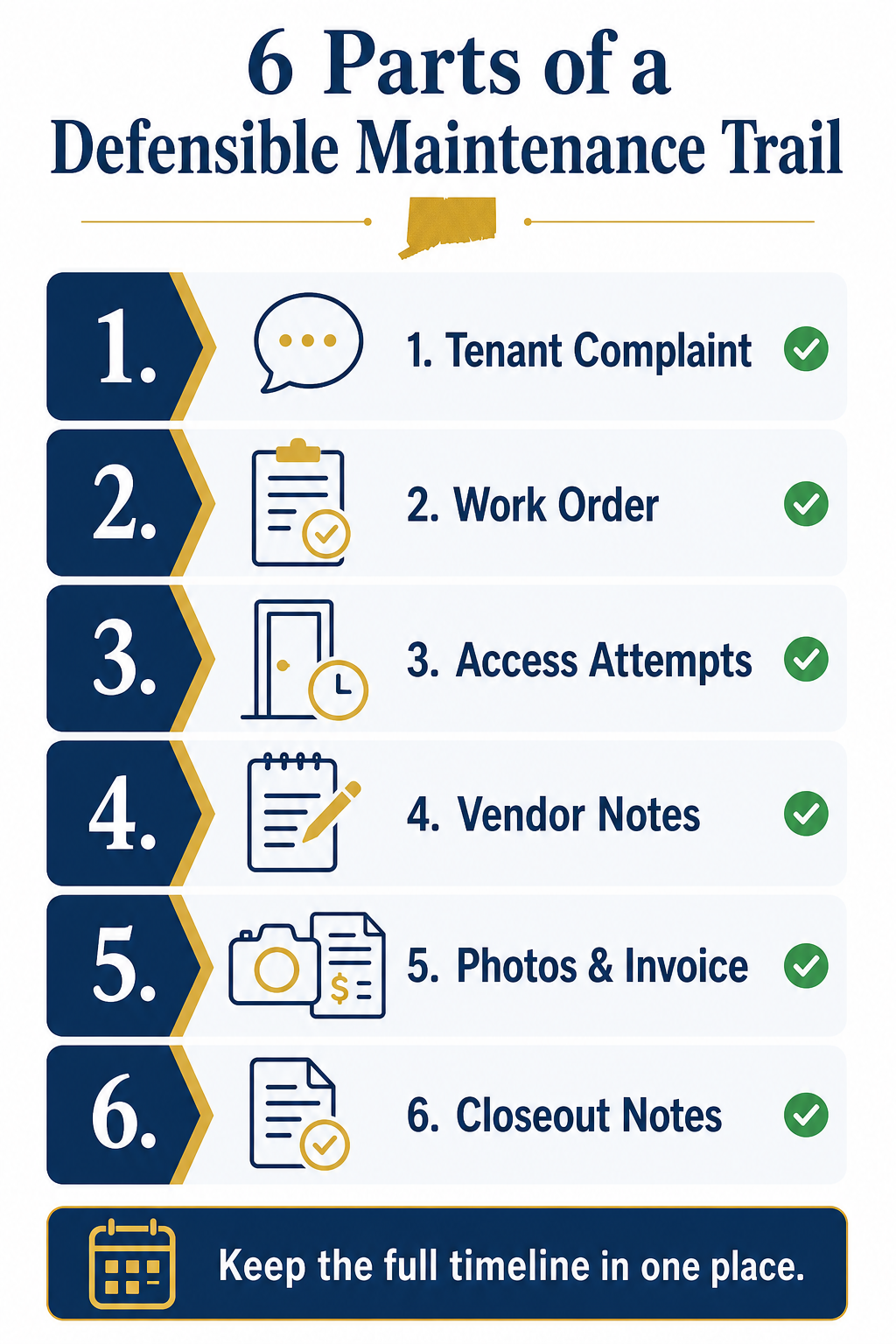
- A maintenance log should include tenant messages, timestamps, work orders, vendor notes, photos, access attempts, and closeout documentation.
- The strongest records show the full timeline, not just the final invoice.
- Access issues should be documented carefully because delayed entry can delay repairs.
- Photos and vendor notes often matter more than memory when a dispute escalates months later.
- A defensible system protects both the property and the owner’s position.
Why Maintenance Records Matter for Connecticut Landlords
Maintenance is not just an operations issue. It can become a legal, financial, and reputational issue.
Under Connecticut landlord-tenant law, landlords are generally responsible for keeping premises fit and habitable, making required repairs, maintaining common areas, and complying with applicable health and safety codes. That does not mean every tenant complaint automatically proves landlord fault. It does mean the owner needs records showing what happened and when.
A clean maintenance log can help answer the questions that come up in disputes:
- When did the tenant first report the issue?
- Was the issue urgent, recurring, or cosmetic?
- How quickly did management respond?
- Was access requested?
- Did the tenant allow entry?
- What did the vendor find?
- Was the repair completed?
- Was the tenant notified after closeout?
- Were photos or invoices saved?
If the answer is “I think we handled it,” that is weak. If the answer is a timestamped trail, that is much better.
For related documentation problems, see Idoni’s guide to Connecticut lease documentation landlords need to get right.
What Belongs in a Defensible Maintenance Log
A useful maintenance log should show the full life cycle of the issue. A spreadsheet with “fixed sink” is not enough.
| Record Type | What It Proves | Example |
|---|---|---|
| Tenant complaint | Date, time, issue, and tenant wording | Tenant reported water under kitchen sink on March 4 at 8:12 AM. |
| Work order | Response and assignment | Work order opened same day and assigned to plumber. |
| Access attempts | Whether management could enter | Text sent requesting access window; tenant unavailable until Friday. |
| Vendor notes | Professional observation | Supply line loose; no active wall leak observed. |
| Photos/video | Condition before and after repair | Before photo, repaired line photo, dry cabinet photo. |
| Closeout note | Completion and tenant communication | Repair completed; tenant notified by email. |
| Invoice/receipt | Cost, vendor, materials, date | Licensed plumber invoice attached to work order. |
The goal is simple: if someone reviews the file later, they should understand the timeline without needing a phone call from the owner.
The Timeline Is Often the Defense
In a maintenance dispute, the issue is rarely just “Was there a repair?” The bigger issue is usually timing.
A tenant may claim the landlord ignored the problem. The landlord may know they responded quickly. The question is whether the file proves it.
A defensible maintenance timeline should show:
- the original complaint date
- the first response date
- the urgency level assigned
- the vendor dispatch date
- every access attempt
- any tenant-caused delay
- vendor findings
- repair completion date
- tenant notification after closeout
This matters for complaints involving heat, water, electrical problems, leaks, mold concerns, pests, appliances, locks, windows, and code enforcement notices. The more serious the allegation, the more important the timeline becomes.
Access Attempts Need Their Own Documentation
Access is one of the most common weak points in landlord maintenance records.
Connecticut law generally allows landlords to enter for legitimate purposes such as inspection, repairs, improvements, services, or showing the unit, but entry must be handled reasonably, and tenants should not unreasonably withhold consent. Emergency situations are different. In normal repairs, owners should avoid casual or undocumented access arrangements.
A strong access record includes:
- date and time access was requested
- method used: text, email, tenant portal, phone call
- proposed entry window
- tenant response
- missed appointment notes
- rescheduled date
- vendor cancellation fees, if any
- final successful entry date
If a repair took longer because the tenant was unavailable, the log should show that clearly. Otherwise, the delay may look like owner neglect.
Photos, Vendor Notes, and Closeout Details Matter
Many owners save invoices but not evidence. That is a mistake.
Invoices prove someone was paid. They do not always prove the condition of the property, the source of the issue, the tenant’s access delays, or the final result.
Better documentation includes:
- photos before repair
- photos during repair, when useful
- photos after completion
- vendor notes in plain English
- cause of issue, if known
- whether tenant use, age, weather, or building condition contributed
- whether follow-up is needed
- whether the issue is fully resolved or temporarily stabilized
This is especially important for water intrusion, mold complaints, pest issues, HVAC failures, plumbing backups, and repeat repairs.
For owners dealing with tenant disputes more broadly, Idoni’s Connecticut eviction process guide explains why documentation often decides how cleanly a case moves.
Maintenance Logs Help With Code Enforcement Complaints
When a tenant contacts local code enforcement, the owner may have to show more than good intentions.
A code inspector, attorney, insurance adjuster, or housing court may care about:
- when the owner learned of the issue
- whether the owner responded promptly
- whether the repair required a licensed trade
- whether parts or vendor availability caused delay
- whether tenant access slowed the repair
- whether temporary safeguards were provided
- whether the final condition was documented
A complete log does not guarantee a dispute disappears. But it gives the owner a factual record instead of a memory contest.
Connecticut Maintenance Risk Trends for 2026
Connecticut rental owners are facing higher expectations around response time, tenant communication, and documentation. Local code enforcement departments, tenant advocates, and housing courts are increasingly focused on timelines, habitability concerns, and proof that owners acted reasonably.
Older multifamily housing in cities like Bridgeport, Hartford, New Haven, Waterbury, and New Britain also creates repeat maintenance exposure. Plumbing, heat, roof leaks, electrical issues, and pest complaints can become expensive fast when records are scattered across text messages, vendor calls, and handwritten notes.
For owners trying to reduce disputes before they start, maintenance operations now need the same discipline as leasing, screening, and rent collection. See Idoni’s post on what professional property managers actually handle for a broader view of the operating systems behind rental management.
Common Mistakes Connecticut Landlords Make With Maintenance Logs
Only saving the invoice
An invoice is useful, but it is not the whole story. It may not show the complaint date, access delays, photos, tenant messages, or final closeout.
Letting tenant messages stay buried in texts
If the original complaint lives in someone’s phone, it may be hard to retrieve later. Maintenance requests should be copied into a central system.
Failing to document access problems
If a tenant cancels twice, refuses entry, or limits availability, that should be logged. Otherwise, the owner may look responsible for the delay.
Closing work orders without closeout notes
“Done” is not enough. A proper closeout says what was repaired, who completed it, whether photos were saved, and whether the tenant was notified.
Not separating urgent repairs from routine repairs
A broken cabinet handle and a no-heat complaint should not move through the same process. Urgent issues need faster escalation and clearer records.
Relying on memory during disputes
Memory fades. A tenant complaint from six months ago can become a serious issue when nobody can reconstruct the timeline.
What Connecticut Landlords Should Do Next
Connecticut landlords should build a maintenance documentation process before the next complaint comes in.
Start with this checklist:
- Use one central system for maintenance requests.
- Require every request to have a timestamp.
- Save tenant messages, photos, vendor notes, invoices, and access attempts together.
- Create categories for emergency, urgent, routine, and cosmetic issues.
- Require closeout notes before marking a repair complete.
- Keep before-and-after photos for major repairs.
- Document tenant-caused delays without emotional language.
- Review repeat issues monthly to spot property-level risks.
- Keep repair records organized by unit and property.
If you already have scattered records, start by standardizing the process going forward. Then clean up the highest-risk open issues first.
FAQs
Do Connecticut landlords need to keep maintenance logs?
Connecticut law does not require every landlord to use a specific maintenance log format. But landlords do have repair and habitability responsibilities, and a maintenance log helps prove how the owner responded when a complaint was made.
What should a landlord document after a tenant reports a repair?
Document the complaint, date and time received, response, urgency level, access request, vendor assignment, vendor findings, photos, invoice, completion date, and tenant closeout message.
Can tenant access delays help defend a landlord?
They can help explain the timeline if documented properly. If a tenant refuses or delays access, the owner should save the access request, tenant response, missed appointments, and rescheduled entry attempts.
Are photos important for landlord maintenance disputes?
Yes. Photos can show the condition before repair, the work performed, and the final condition. They are especially useful for leaks, mold claims, pest issues, damage disputes, and code complaints.
Should small landlords use property management software?
Small landlords do not always need complex software, but they do need a central record. A simple system is fine if it consistently captures tenant messages, work orders, access attempts, photos, vendor notes, and closeout details.
How Idoni Management Can Help
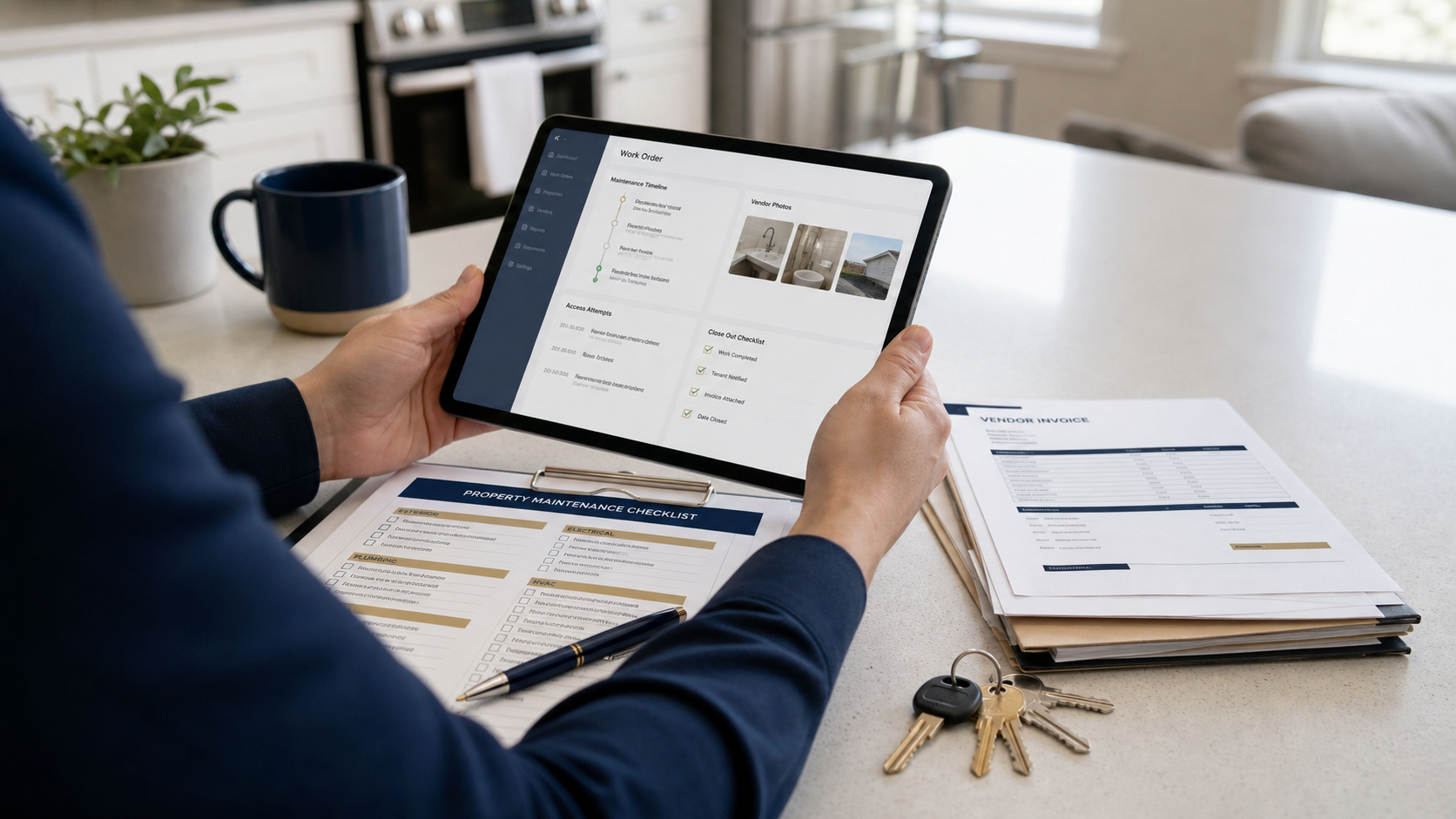
A maintenance log is only useful if the process is followed every time. Idoni Management helps Connecticut landlords turn scattered repair tasks into a defensible operating trail: work orders, tenant messages, vendor photos, access attempts, invoices, and closeout notes in one place.
Over 200 Connecticut landlords trust Idoni Management to handle their rental properties across Bridgeport, Hartford, Waterbury, New Haven, and surrounding markets. See what owners say or request an operations review for your rental portfolio.
Want a maintenance paper trail that protects the asset? Ask for an Idoni operations review.
This article is for educational purposes only and is not legal advice. Connecticut landlords should consult a qualified attorney about specific disputes, notices, or court matters.