

Bridgeport Code Violations: A Landlord Diagnostic Before the City Finds the Problem
Bridgeport code violations usually start as ordinary rental operations problems: a missed repair, weak documentation, poor tenant follow-up, unclear vendor ownership, or a unit condition that no one checked after the last turnover. For Bridgeport landlords, the real risk is not just the violation itself. It is the delay, tenant frustration, municipal pressure, and lost owner confidence that follow when there is no visible system for fixing the problem.
This guide gives Connecticut rental owners a practical diagnostic to run before the city, tenant, or inspector forces the issue. It is not legal advice and it does not replace a licensed attorney, contractor, or municipal official. It is an operator checklist for catching housing-code risk early and turning scattered repair work into documented proof.
Key Takeaways
- Bridgeport code problems are usually preventable when inspections, tenant complaints, vendor updates, and owner approvals are tracked in one place.
- The dangerous gap is often documentation, not just the repair. If you cannot prove what was reported, assigned, completed, and sent to the inspector, you are exposed.
- Landlords should separate urgent life-safety issues from ordinary maintenance and move smoke, heat, electrical, plumbing, water intrusion, and access problems first.
- Photos, invoices, inspector emails, and tenant communications should be saved as a proof packet for each compliance issue.
- Idoni Management uses owner visibility, escalation tracking, vendor coordination, and inspection follow-up to reduce repeat violations and missed deadlines.
Why Bridgeport Code Violations Become Expensive
Most owners do not get into trouble because they ignore every repair. They get into trouble because the repair trail is messy.
A tenant reports an issue. A vendor is called. Someone says the work was done. The city asks for proof. The owner asks what happened. The manager has to reconstruct the timeline from texts, emails, work orders, photos, and memory.
That is a bad system.
Bridgeport rental owners should assume every serious habitability issue may eventually need a clean timeline:
- when the issue was reported
- who received it
- who was assigned
- what the vendor found
- what work was approved
- when it was completed
- what proof was sent to the tenant, owner, or inspector
- what remains open
If that timeline is missing, the problem can look unmanaged even when people are working on it.
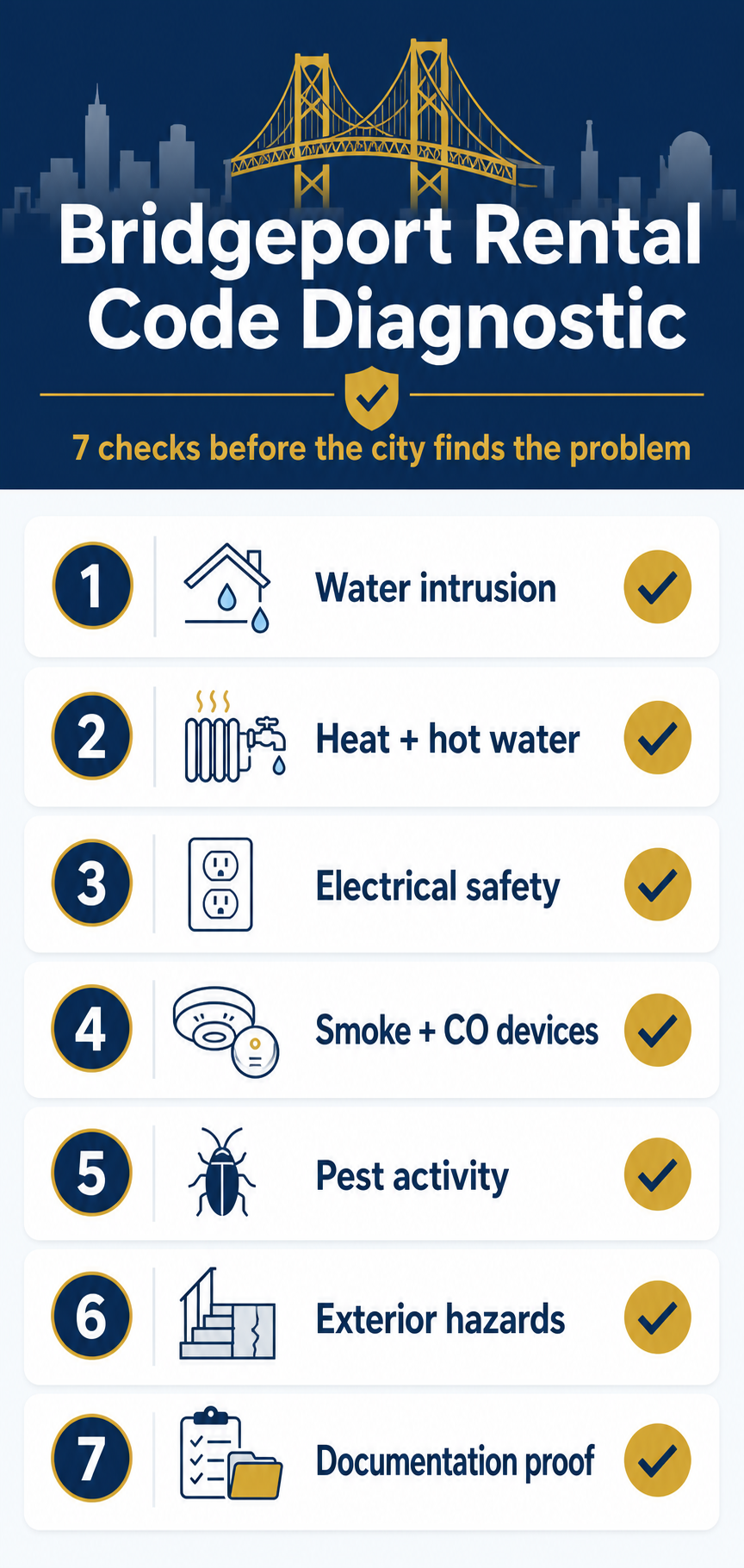
The Landlord Diagnostic: What To Check Before the City Finds It
Use this diagnostic on occupied rentals, vacant units, and any property with recent complaints or deferred maintenance.
| Risk Area | What To Look For | Why It Matters |
|---|---|---|
| Life safety | Smoke detectors, CO detectors, loose wiring, broken locks, blocked exits | These issues can escalate quickly and should not sit behind cosmetic repairs. |
| Water and plumbing | Leaks, sewer backups, slow drains, active water intrusion, damaged ceilings | Water issues spread fast and create mold, tenant claims, and repair disputes. |
| Heat and utilities | No heat, recurring power loss, tripping breakers, nonworking hot water | Utility problems trigger urgent tenant pressure and potential municipal involvement. |
| Exterior conditions | Loose stairs, railings, porches, broken windows, falling masonry, trash | Exterior violations are visible and often become city-facing quickly. |
| Unit condition | Holes, pests, damaged flooring, missing appliances, unsafe doors | Small condition problems become larger when ignored across multiple inspections. |
| Documentation | Missing photos, vendor notes, tenant replies, inspector emails, invoices | Without proof, completed work may still look unresolved. |
The goal is not perfection. The goal is to know what is open, what is assigned, what is completed, and what proof exists.
The Documentation Problem Most Owners Miss
Many landlords focus on the repair and forget the evidence.
That is backwards. In a code-violation situation, the proof trail is part of the repair.
A clean proof packet should include:
- the original notice or complaint
- before photos
- vendor estimate or work order
- owner approval, if needed
- completion photos
- invoice or paid receipt
- tenant access notes
- email to the inspector or municipal contact
- final signoff or reinspection result
This is especially important if the issue touches the eviction process, tenant noncooperation, access problems, or disputed responsibility. The owner needs a record showing that management acted, not just a verbal update saying someone is “on it.”
How To Prioritize Bridgeport Rental Repairs
Not every repair deserves the same level of urgency. Code-related work should be triaged by risk, deadline, and proof.
First: life-safety and habitability
Move these ahead of cosmetic work:
- smoke and carbon monoxide detectors
- electrical hazards
- active water leaks
- no heat or hot water
- blocked exits or broken entry locks
- structural hazards
- sewage, pest, or sanitation issues
Second: inspector deadlines and reinspection dates
If the city has issued a deadline, the repair plan should work backward from that date. The important question is not “Did we call someone?” It is “Will we have completion proof before the reinspection?”
Third: owner approvals and cost clarity
If an owner approval is needed, send the final owner approval amount, the scope, the risk of delay, and the target completion date. Do not bury the owner in vendor confusion or internal coordination math.
Fourth: cosmetic and ordinary maintenance
Paint, trim, minor adjustments, and nonurgent items still matter. They just should not block life-safety, habitability, or inspector deadline work.
How Bridgeport Landlords Can Reduce Repeat Violations
The best code-violation strategy is not heroic repair work after a notice. It is a repeatable operating system.
Bridgeport landlords should use:
- periodic property walks
- photo logs before and after turnovers
- work orders tied to specific units and issues
- escalation rules for life-safety complaints
- vendor response tracking
- owner approval tracking
- inspector communication logs
- final proof packets for closed issues
This same discipline helps with lease documentation, tenant disputes, security deposit deductions, insurance claims, and owner reporting.
Common Mistakes Connecticut Landlords Make With Code Violations
- Waiting for the written violation before checking obvious risk areas.
- Treating tenant complaints as isolated messages instead of evidence in a timeline.
- Closing a repair because a vendor said it was done without completion photos.
- Missing reinspection dates or failing to confirm the inspector received proof.
- Sending owner updates that say “we are working on it” without dates, scope, and next proof item.
- Mixing urgent life-safety items with ordinary maintenance in the same low-priority queue.
- Failing to connect tenant access issues, legal status, and repair timing when an occupied unit is difficult to enter.
The fix is boring in the best way: one issue, one owner, one property timeline, one proof packet.
What Connecticut Landlords Should Do Next
If you own rental property in Bridgeport, run a fast compliance check this week:
- Walk the exterior and common areas.
- Review the last 90 days of tenant complaints.
- Pull open work orders and identify anything tied to safety, water, heat, electricity, locks, pests, or city notices.
- Confirm every urgent item has an owner, vendor, deadline, and proof requirement.
- Build a simple folder for notices, photos, invoices, inspector emails, and final signoffs.
- Review your security deposit and turnover documentation habits before the next move-out.
- Tighten tenant screening and onboarding so tenants know how to report repair issues properly.
If you cannot answer what is open, who owns it, and what proof exists, the property is running on memory. That is not a system.
FAQs
What should a Bridgeport landlord do after receiving a code violation?
Read the notice carefully, identify each item, assign a vendor or internal owner, document access attempts, gather before photos, and work backward from any deadline or reinspection date. If the notice involves legal risk, tenant access problems, or possible penalties, speak with a qualified attorney or the appropriate municipal contact.
Do landlords need photos for code-violation repairs?
Photos are not just helpful. They are often the fastest way to prove progress. Keep before photos, completion photos, vendor notes, invoices, and any inspector email in the same folder so the timeline is easy to defend.
What repairs should landlords prioritize first?
Prioritize life-safety and habitability issues first: smoke and CO detectors, heat, hot water, active leaks, electrical hazards, broken locks, blocked exits, pests, sewage, and structural concerns.
Can a property manager help with Bridgeport code violations?
Yes, if the manager has a real operating system. The value is not just calling vendors. It is tracking deadlines, coordinating access, getting owner approvals, documenting completion, and communicating clearly with tenants, owners, and inspectors.
How can landlords prevent repeat code violations?
Use recurring inspections, clean tenant intake, documented maintenance workflows, photo proof, vendor accountability, and owner reporting. Repeat violations usually come from weak follow-through, not one bad repair.
How Idoni Management Can Help
Idoni Management helps Connecticut landlords turn code issues, maintenance requests, tenant complaints, and inspection deadlines into a visible operating system. We manage rental properties across Bridgeport, Waterbury, Hartford, New Britain, Norwalk, and surrounding Connecticut markets with a focus on owner visibility and practical follow-through.
Over 200 Connecticut landlords trust Idoni Management. If you are worried about Bridgeport code violations, stale repairs, tenant complaints, or weak documentation, we can run a rental operations checkup and show you where the risk is hiding.