
Why Owner Updates Matter More Than Connecticut Landlords Realize
Most owner frustration does not start with the repair, the tenant complaint, or the city violation. It starts with silence. A landlord can usually handle bad news: a leaking pipe, a late rent payment, a failed inspection, a tenant dispute, or a vendor delay. What breaks trust is feeling blind while someone else is supposedly “handling it.”
That is why owner updates matter more than many landlords and property managers realize. Communication is not a courtesy layer. It is part of the operating system. A clear update tells the owner what happened, what is being done, who owns the next action, what is blocked, and when they should expect to hear back. Without that, every issue feels worse than it is.
Key Takeaways
- Owners get most frustrated when they feel uninformed, not just when something goes wrong.
- Silence makes repairs, tenant problems, and city violations feel larger and riskier.
- Good updates should include the issue summary, next action, responsible party, vendor status, risk, and cadence.
- “We’re handling it” is not a management system. It is a trust leak.
- Idoni Management builds owner communication into the daily process so landlords know what is happening before they have to ask.
The Real Reason Owners Get Angry
Owners rarely expect rental property to be problem-free.
They know tenants call. They know toilets clog. They know vendors run late. They know towns can issue notices. They know some repairs reveal bigger problems once someone opens a wall.
What they do not tolerate well is uncertainty.
Uncertainty creates a story. And when the owner does not have facts, the story usually sounds like this:
- “Are they ignoring this?”
- “Is the tenant mad?”
- “Is this going to become a bigger legal issue?”
- “Did the vendor even show up?”
- “Why am I paying a manager if I have to chase them?”
That story does more damage than the repair itself. A $450 plumbing issue with clear communication feels manageable. A $450 plumbing issue with three days of silence feels like negligence.
Same repair. Completely different owner experience.
Silence Turns Normal Property Problems Into Trust Problems
Every rental property has friction. The question is whether that friction gets managed in a way that builds confidence or erodes it.
| Situation | What the owner sees without updates | What a good update does |
|---|---|---|
| Repair request | “No one is on top of this.” | Confirms the issue, vendor status, and next step. |
| Tenant complaint | “This could spiral.” | Explains the tenant concern and management response. |
| City notice | “Am I exposed?” | Identifies deadline, risk, documentation, and owner decision needed. |
| Vendor delay | “The manager forgot.” | Shows the delay, follow-up, and alternate plan if needed. |
| Owner approval needed | “Why is this stuck?” | Makes the blocker explicit and easy to resolve. |
Owners do not need a novel every time something happens. They need the right facts at the right moment.
The Difference Between “Handling It” and Actually Managing It
A lot of property managers hide behind vague reassurance.
- “We’re on it.”
- “We’re handling it.”
- “We’ll keep you posted.”
That sounds fine for about five minutes. Then the owner starts wondering what “it” means, who is doing the handling, and when “posted” is supposed to happen.
Real management is more specific. A useful owner update should answer five questions:
- What happened?
- What is the next action?
- Who owns that action?
- What is blocking progress, if anything?
- When will the next update happen?
That simple structure removes most of the anxiety from the situation. It also protects the manager. When the record is clear, there is less room for confusion, misremembered conversations, or last-minute blame.
This is the same reason strong lease documentation matters. If it is not written down clearly, it becomes a mess later.
What Idoni Includes in Owner Updates
Idoni Management treats communication as part of the work, not an afterthought.
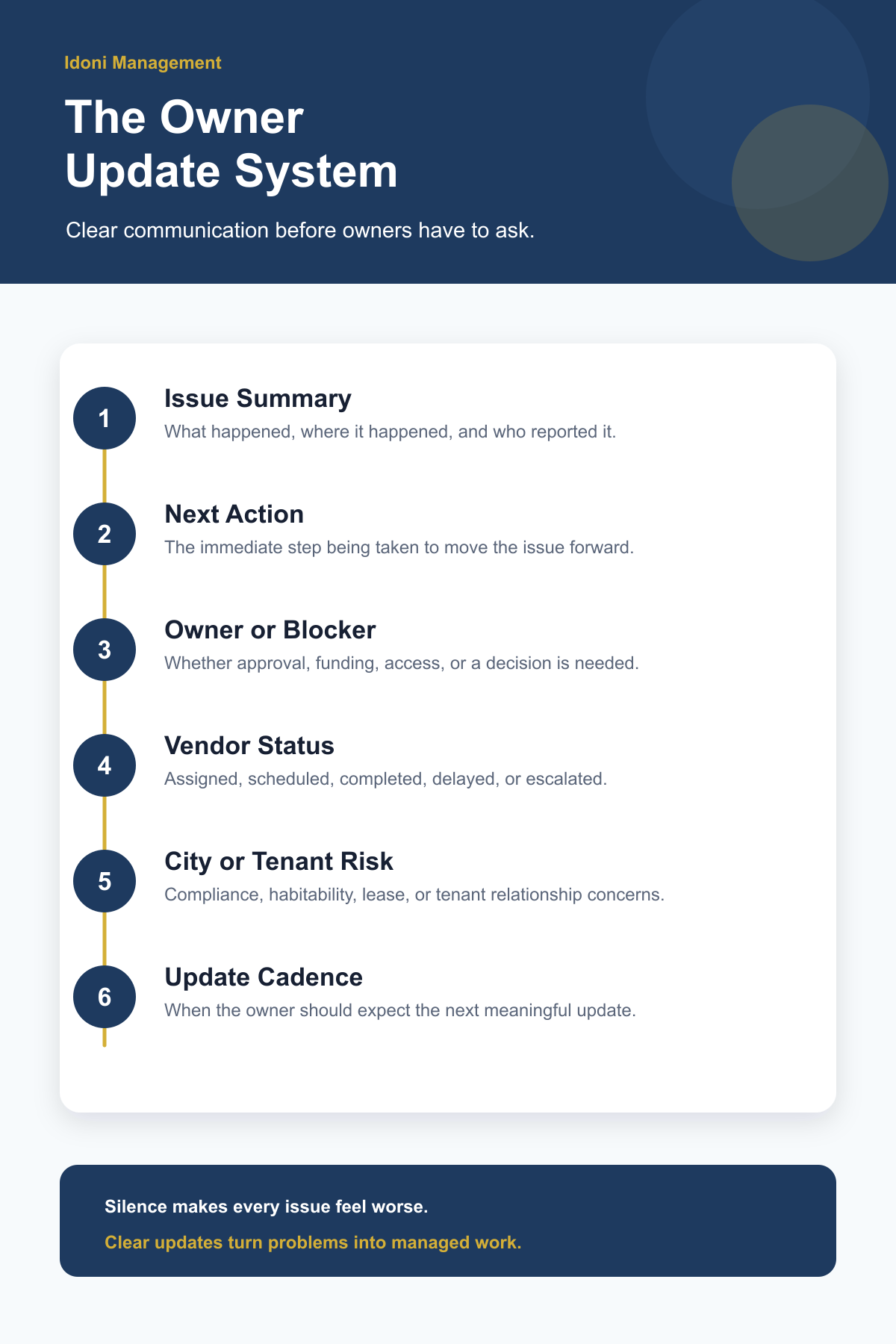
For active issues, owner updates should include:
- Issue summary: What happened, where it happened, and who reported it.
- Next action: The immediate step being taken.
- Owner or blocker: Whether the owner needs to approve, decide, fund, or provide information.
- Vendor status: Whether the vendor has been assigned, scheduled, completed, delayed, or escalated.
- City or tenant risk: Whether there is a compliance, relationship, habitability, lease, or documentation concern.
- Update cadence: When the owner should expect the next communication.
That last one matters. A manager can send a perfect update and still create frustration if the owner has no idea when they will hear the next one.
“Vendor is scheduled for Thursday. We’ll update you after the appointment or sooner if the tenant reports a change.”
That is not fancy. It is just competent. And competence compounds.
Owner Communication Is Not Just Customer Service
This is where many landlords underestimate the issue.
Owner updates are not just about being polite. They affect:
- decision speed
- repair timelines
- tenant satisfaction
- city compliance
- documentation quality
- owner retention
- trust in management
A delayed approval can turn a small repair into a bigger one. A missing vendor update can make the owner think nothing is happening. A poorly explained tenant issue can make a landlord overreact or underreact.
Communication is operational control.
That is why the best management companies do not rely on memory, scattered texts, or heroic individual effort. They build repeatable systems.
If you are comparing managers, do not only ask about rent collection and maintenance pricing. Ask how they communicate when something goes wrong. You can also review what property management services should actually include before signing with a company.
Connecticut Owner Communication Trends in 2026
Connecticut landlords are becoming less tolerant of vague management. Rents are higher, repairs are more expensive, insurance is tighter, and city compliance issues can move quickly. Owners want speed, but they also want visibility.
In markets like Bridgeport, Waterbury, Hartford, and New Haven, the difference between a calm owner and an angry owner often comes down to whether the manager explains the issue before the owner has to chase it.
That is the new bar. Not perfect properties. Clear management.
Common Mistakes Connecticut Landlords Make With Owner Updates
Mistake 1: Accepting vague updates from managers
If every update sounds like “we’re working on it,” the owner is still blind. Ask for the next action, owner or blocker, and timeline.
Mistake 2: Waiting until there is a problem to ask about communication
Communication standards should be discussed before management starts. Once there is a city violation, upset tenant, or emergency repair, vague expectations become expensive.
Mistake 3: Confusing frequency with clarity
More messages do not always mean better communication. A short, structured update beats five scattered texts.
Mistake 4: Not documenting owner decisions
If the owner approves a repair, rejects a recommendation, delays funding, or chooses a lower-cost option, that should be documented. This protects everyone.
Mistake 5: Treating tenant risk and city risk the same as normal maintenance
Some issues are just repairs. Others have lease, habitability, inspection, or enforcement consequences. Those need clearer escalation.
For example, city-related issues should be handled differently than routine maintenance, just as eviction-related problems require tighter documentation. Landlords dealing with tenant enforcement issues should understand the basics of the Connecticut eviction process before things reach that stage.
What Connecticut Landlords Should Do Next
If you own rental property and feel like you are always chasing your manager for updates, do not ignore that signal.
Use this checklist:
- Ask your manager what triggers an owner update.
- Ask how repair, tenant, vendor, and city issues are tracked.
- Ask who owns follow-up when a vendor delays.
- Ask whether owner approvals are documented.
- Ask how often active issues are updated.
- Ask what information appears in each update.
The answer should not depend on one person “being good at communication.” It should be built into the management process.
FAQs
How often should a property manager update an owner?
For normal activity, monthly reporting may be enough. For active repairs, tenant issues, vendor delays, or city notices, owners should receive updates based on the urgency of the issue and the next meaningful action.
What should be included in a property management owner update?
A strong update should include the issue summary, next action, responsible party, blocker or owner decision needed, vendor status, risk level, and expected next update.
Why do landlords get frustrated with property managers?
Many landlords are not frustrated only because something went wrong. They are frustrated because they do not know what is happening, what has been done, or what comes next.
Is owner communication part of property management?
Yes. Communication is a core part of management because it affects repairs, tenant relationships, compliance, documentation, and owner trust.
What should I ask before hiring a property manager?
Ask how the company handles updates during repairs, tenant problems, late payments, city notices, and vendor delays. Also ask how approvals and decisions are documented. If pricing is part of your comparison, review the company’s property management pricing alongside its operating process.
How Idoni Management Can Help
Idoni Management gives Connecticut rental owners clearer visibility into what is happening at their properties. We handle maintenance coordination, tenant communication, vendor follow-up, city and compliance issues, and owner reporting across Bridgeport, Hartford, Waterbury, New Haven, and surrounding markets.
Over 200 Connecticut landlords trust Idoni Management to handle their rental properties. See what they say or book an Idoni management review to see where your current management process is creating unnecessary risk.