

The Section 8 Inspection Trap Connecticut Owners Don’t See Coming
Section 8 tenants can be strong, steady renters for Connecticut landlords. The problem usually is not the voucher. It is the inspection process between an accepted applicant and the first reliable housing assistance payment. Before a Housing Choice Voucher tenancy is approved, the unit must meet HUD quality and safety standards, the rent must be approved, the paperwork must clear, and the local housing authority or program administrator must complete its process. A failed inspection, missing repair, unclear communication, or slow reinspection can turn a promising lease-up into weeks of dead time.
For Connecticut owners, the smart move is to treat Section 8 inspection readiness as an operating system, not an appointment. That means checking the unit before the inspector arrives, documenting repairs, coordinating quickly with the tenant and housing authority, and giving the owner clear visibility into the timeline. If you want voucher income, you need a process that protects it before the unit sits.
Key Takeaways
- Section 8 lease-up can stall if the unit does not pass inspection before the tenancy is approved.
- Failed inspections often come from ordinary issues: smoke/CO detectors, handrails, peeling paint, windows, locks, plumbing, electrical covers, leaks, pests, and trip hazards.
- Connecticut owners may deal with different public housing authorities or program administrators depending on the town and voucher source.
- The real cost of a failed inspection is not just the repair. It is vacancy, rescheduling, delayed rent start, and owner confusion.
- A checklist-driven inspection workflow helps owners capture voucher opportunity without letting the process drift.
- Idoni Management treats inspection readiness as part of lease-up, not as an afterthought.
Why Section 8 Inspections Become the Hidden Bottleneck
Most owners think the big decision is whether to accept a voucher tenant.
That is the wrong place to stop.
The real test is whether the property can move from application to approved tenancy without losing momentum. In the Housing Choice Voucher program, the tenant generally chooses a private rental, the owner agrees to participate, and the unit must meet program requirements before assistance is paid to the landlord.
That creates a middle zone where money is close, but not yet real.
The owner may have:
- an interested tenant
- a rent number under review
- a unit that looks basically ready
- a scheduled inspection
- a move-in target
But if the inspector finds repair items, the clock changes. The lease-up is no longer about marketing or screening. It becomes about coordination.
That is where owners lose weeks.
The Inspection Is Not the Problem. Drift Is the Problem.
Voucher inspections are not mysterious. They are looking for basic habitability, safety, and program compliance. The trouble is that many owners approach them casually.
They assume:
- The unit rented before, so it should pass.
- The handyman will catch anything obvious.
- If it fails, we will just fix it.
- The tenant and housing authority will keep everything moving.
That thinking is expensive.
A failed inspection can mean more vacancy days, another scheduling cycle, more calls, more uncertainty, and a tenant who may keep looking. For an owner carrying a mortgage, taxes, insurance, utilities, and turnover costs, a few weeks of delay is not a technicality. It is lost income.
If you are new to the operational side of leasing, Idoni’s guide to Connecticut lease documentation is a useful companion because inspection readiness and lease paperwork need to move together.
Common Section 8 Inspection Issues Connecticut Owners Should Check First
Every housing authority may have its own process and forms, but owners should assume the unit needs to be clean, safe, functional, and ready for a tenant to occupy.
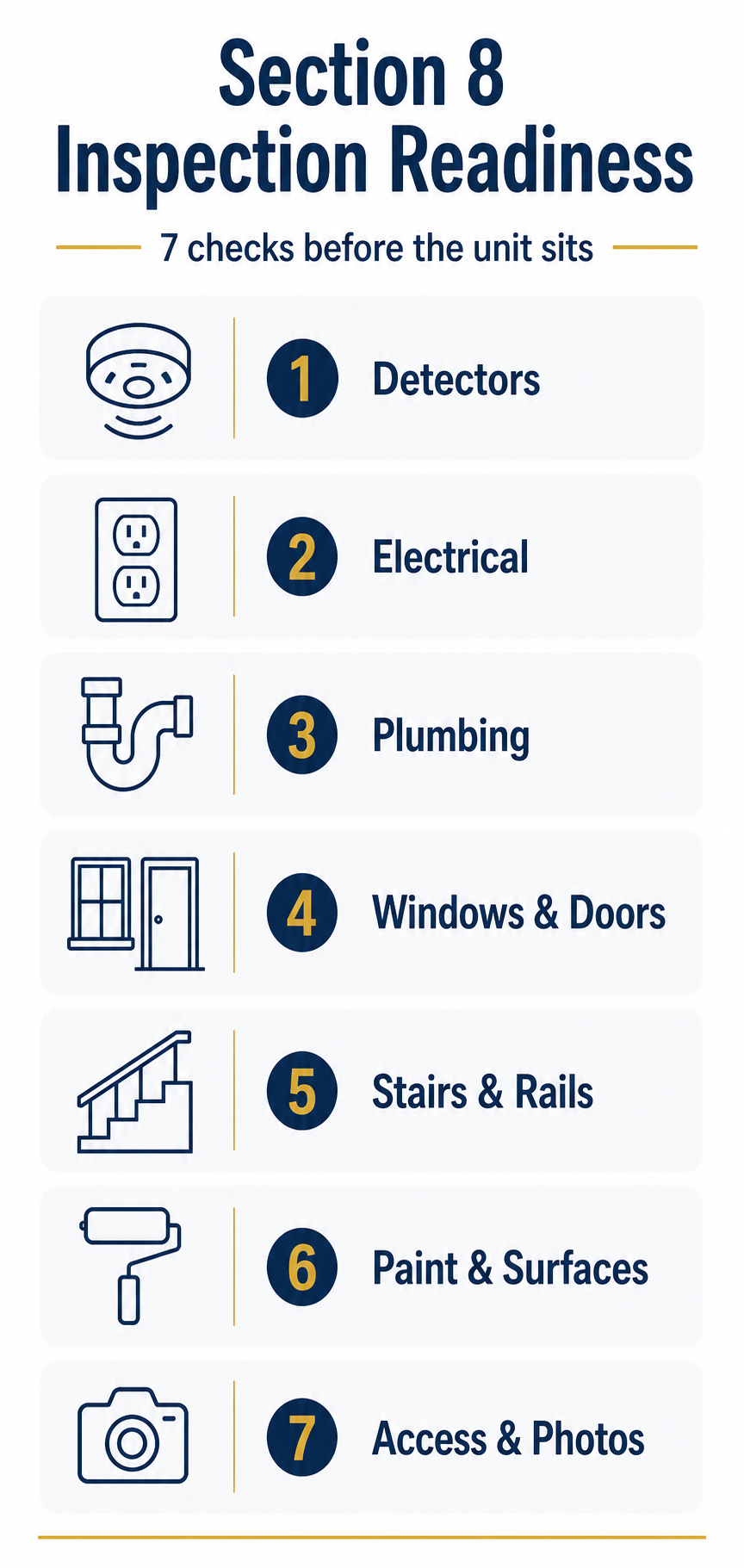
Here is a practical pre-inspection checklist:
| Area | What to Check Before Inspection | Why It Matters |
|---|---|---|
| Smoke and CO detectors | Correct placement, working batteries, proper installation | Missing or non-working detectors can stop approval fast. |
| Electrical | Outlet covers, exposed wiring, panel covers, working fixtures | Inspectors look closely at safety hazards. |
| Plumbing | Leaks, drainage, hot water, secure fixtures | Small leaks can become inspection failures and owner headaches. |
| Heat and appliances | Working heat, stove, refrigerator, water heater | Essential systems must be functional. |
| Windows and doors | Locks, safe operation, no broken glass | Security and safe egress matter. |
| Stairs and handrails | Secure railings, stable steps, no trip hazards | Falls and loose rails are common preventable issues. |
| Paint and surfaces | Peeling paint, damaged walls, unsafe flooring | Especially important in older housing stock. |
| Exterior | Debris, unsafe porches, lighting, entry conditions | Inspectors do not only look inside the unit. |
| Pest and sanitation | No infestation, trash, or unsafe conditions | A clean turnover helps avoid avoidable delays. |
This is not legal advice, and it is not a substitute for the inspection standards used by the specific housing authority. It is the owner’s first pass before the official pass.
The Real Cost of a Failed Section 8 Inspection
A failed inspection is rarely just fix the item and move on.
For an owner, the cost can stack quickly:
- vacancy continues while repairs are completed
- the tenant may delay move-in or choose another unit
- a reinspection must be scheduled
- the rent start date may move
- the owner may not understand who is waiting on whom
- contractors may need access to a vacant or partially ready unit
- paperwork may expire or need correction
This is why old-school property management struggles with voucher lease-ups. Treating the inspection like a calendar event misses the actual risk.
The inspection is a workflow.
And workflows need ownership.
How Idoni Manages Section 8 Inspection Readiness
Idoni Management does not treat voucher inspections as one-off appointments. We manage them as a lease-up system.
That system has four parts.
1. Repair Readiness
Before inspection day, the unit needs a targeted review. Not a casual glance. Not a looks-fine-from-the-doorway walkthrough.
We look for the items that most commonly slow down approval:
- detector issues
- missing covers
- leaks
- loose railings
- damaged windows or doors
- peeling paint
- non-working appliances
- unsafe exterior conditions
The goal is simple: do the obvious work before the inspector has to tell you.
2. Inspection Coordination
The owner, tenant, housing authority, and vendor all need the same basic information:
- inspection date and time
- access instructions
- repair responsibility
- tenant communication
- reinspection requirements if needed
- next step after approval
Without coordination, everybody waits. Nobody owns the delay. That is how income gets stuck.
3. Owner Visibility
Owners should not have to guess whether the unit passed, failed, or is waiting for a call back.
Good management gives the owner a clear view:
- what was checked
- what failed, if anything
- who is handling repairs
- when the repair is expected to be complete
- when reinspection is requested or scheduled
- what remains before payment begins
Voucher income feels risky when the owner cannot see the process. Visibility lowers the anxiety.
4. Fast Follow-Through
Speed matters after a failed inspection.
The best time to solve a failed item is immediately, before the tenant loses confidence and the housing authority schedule slips further out. That requires vendor access, repair documentation, and someone responsible for pushing the file forward.
This is where a property manager either earns their fee or proves they are just forwarding emails.
For owners comparing management approaches, see Idoni’s breakdown of what property managers actually do. Section 8 inspection coordination is a perfect example of where operations matter more than slogans.
Connecticut Voucher Leasing Trends Owners Should Understand
Connecticut’s Housing Choice Voucher system is not one single front desk. The state notes that vouchers are administered through many public housing agencies and statewide program partners, which means the owner experience can vary by municipality, administrator, and voucher source.
That variation is exactly why owners need a process. Strong voucher demand can help fill units, but local inspection scheduling, rent approval, and repair follow-up can still create friction. The owners who do best are not the ones who accept Section 8 in theory. They are the ones who can operationalize the lease-up in practice.
Common Mistakes Connecticut Landlords Make With Section 8 Inspections
Mistake 1: Waiting for the inspector to create the punch list
That gives control of the timeline to the failure notice. Owners should create their own punch list first.
Mistake 2: Treating Section 8 tenants as the risk
The tenant is often not the operational problem. The process is. A good tenant with a voucher still needs a unit that passes, a rent that clears, and paperwork that moves.
Mistake 3: Starting repairs after the inspection instead of before it
Some owners try to save money by doing only what the inspector flags. That can work, but it often costs more in vacancy time than it saves in repairs.
Mistake 4: Failing to document completed work
Photos, invoices, access notes, and repair confirmations help keep the process moving. Memory is not a management system.
Mistake 5: Assuming all housing authorities move the same way
Connecticut owners may work with different PHAs or administrators depending on the property and voucher. Local process matters.
Mistake 6: Ignoring the lease and rent approval timeline
Inspection readiness is only one piece. Owners also need clean leasing documents, approved rent, and a clear understanding of the payment start process. For related owner risks, review Idoni’s article on tenant screening and owner decision-making.
What Connecticut Landlords Should Do Next
Before you commit to a voucher lease-up, build an inspection-readiness plan.
Start with this:
- Identify the housing authority or administrator involved.
- Confirm the inspection process and required forms.
- Walk the unit with a Section 8 readiness checklist.
- Fix obvious safety, habitability, and access issues before inspection.
- Photograph completed repairs.
- Set clear access instructions for inspection day.
- Keep the tenant updated without making promises you cannot control.
- Track failed items, repair responsibility, and reinspection status in writing.
- Do not assume rent begins just because the tenant wants the unit.
Owners who want voucher income should not avoid Section 8 because the process has friction. They should manage the friction.
That is the wedge.
The opportunity is real. The risk is operational.
FAQs
Do Section 8 rentals in Connecticut need an inspection before move-in?
In the Housing Choice Voucher program, the unit generally must meet HUD quality and safety standards and be approved before housing assistance payments begin. The exact process can vary by housing authority or program administrator.
What happens if my unit fails a Section 8 inspection?
The owner usually needs to correct the failed items and coordinate a reinspection or confirmation process. The practical risk is delayed lease-up and delayed subsidy payments, especially if repairs or scheduling drag.
Are Section 8 tenants bad renters?
No. A voucher does not make someone a bad renter. Owners should apply lawful, consistent screening standards and focus on the tenant’s rental history, income portion, references, and lease compliance. The bigger issue in many voucher lease-ups is operational coordination.
What repairs commonly delay Section 8 approval?
Common issues include missing smoke or carbon monoxide detectors, leaks, electrical hazards, broken windows, unsafe stairs or railings, peeling paint, appliance problems, pest conditions, and exterior safety hazards.
Should Connecticut landlords accept Section 8 vouchers?
Many owners should consider it, especially if they want stable demand and direct subsidy payments. But they should do it with a process for inspection readiness, rent approval, lease documentation, and repair follow-through.
How Idoni Management Can Help
Idoni Management helps Connecticut rental owners turn Section 8 lease-up from a guessing game into a managed process. We handle repair readiness, inspection coordination, owner updates, vendor follow-through, and lease-up operations for landlords across Bridgeport, Hartford, Waterbury, New Haven, and surrounding towns.
Over 200 Connecticut landlords trust Idoni Management to handle their rental properties. See what they say or get an inspection-readiness plan before your unit sits.
This article is for educational purposes only and is not legal advice. Connecticut landlords should confirm requirements with the applicable housing authority or speak with a qualified attorney about specific disputes, notices, or court matters.