

Waterbury Vendor Accountability Scorecard: 7 Metrics That Expose Slow, Expensive Maintenance
Waterbury rental owners should measure maintenance vendors on seven things: acknowledgment speed, on-time arrival, repair cycle time, first-visit resolution, repeat work, quote-to-invoice variance, and proof of completion. A low invoice is not a bargain if the vendor takes four days to arrive, makes three trips, leaves the resident uninformed, and cannot produce a clear scope or completion photo. A monthly vendor scorecard turns those hidden costs into evidence. It helps an owner keep reliable contractors, correct weak performance, and stop rewarding the cheapest estimate when it produces the most expensive outcome. It also shows which vendor should receive the next assignment. The scorecard below is designed for small and midsize Connecticut rental portfolios and can be tracked in a property management system, spreadsheet, or work-order platform.
Key Takeaways
- Grade every vendor monthly on the same seven metrics and weight the score to 100 points.
- Use median response and completion times so one extreme job does not distort performance.
- Track a 30-day repeat-work rate; callbacks often reveal poor diagnosis or rushed workmanship.
- Require written approval for quote-to-invoice changes instead of accepting surprise charges.
- Close no work order without a completion note, invoice, and time-stamped photo when the repair can be photographed.
- Treat the targets below as operating standards to calibrate, not legal deadlines.
Why Waterbury Rental Owners Need a Vendor Scorecard
Maintenance spending usually looks clean only at the invoice level. The real cost is spread across resident callbacks, staff follow-up, emergency premiums, lost rent, failed inspections, owner disputes, and a repair that has to be done twice.
That is why effective property management services do more than dispatch a contractor. The manager must define urgency, control authorization, track the work, verify completion, communicate with the resident, and preserve the evidence.
Connecticut General Statutes § 47a-7 generally requires landlords to comply with applicable health-and-safety codes, make necessary repairs, keep premises fit and habitable, maintain supplied systems, and keep common areas clean and safe. The statute does not give every repair the same clock. A no-heat call in January and a loose cabinet pull are not equal. Your workflow should classify the risk before the vendor is assigned.
Waterbury also has local inspection, permitting, blight, and landlord-registration processes. The city’s Department of Inspections administers building, electrical, plumbing, and heating permits. A weak vendor can therefore create more than a resident-service problem. Unpermitted work, missing documentation, or an unresolved condition can become a compliance and ownership problem.
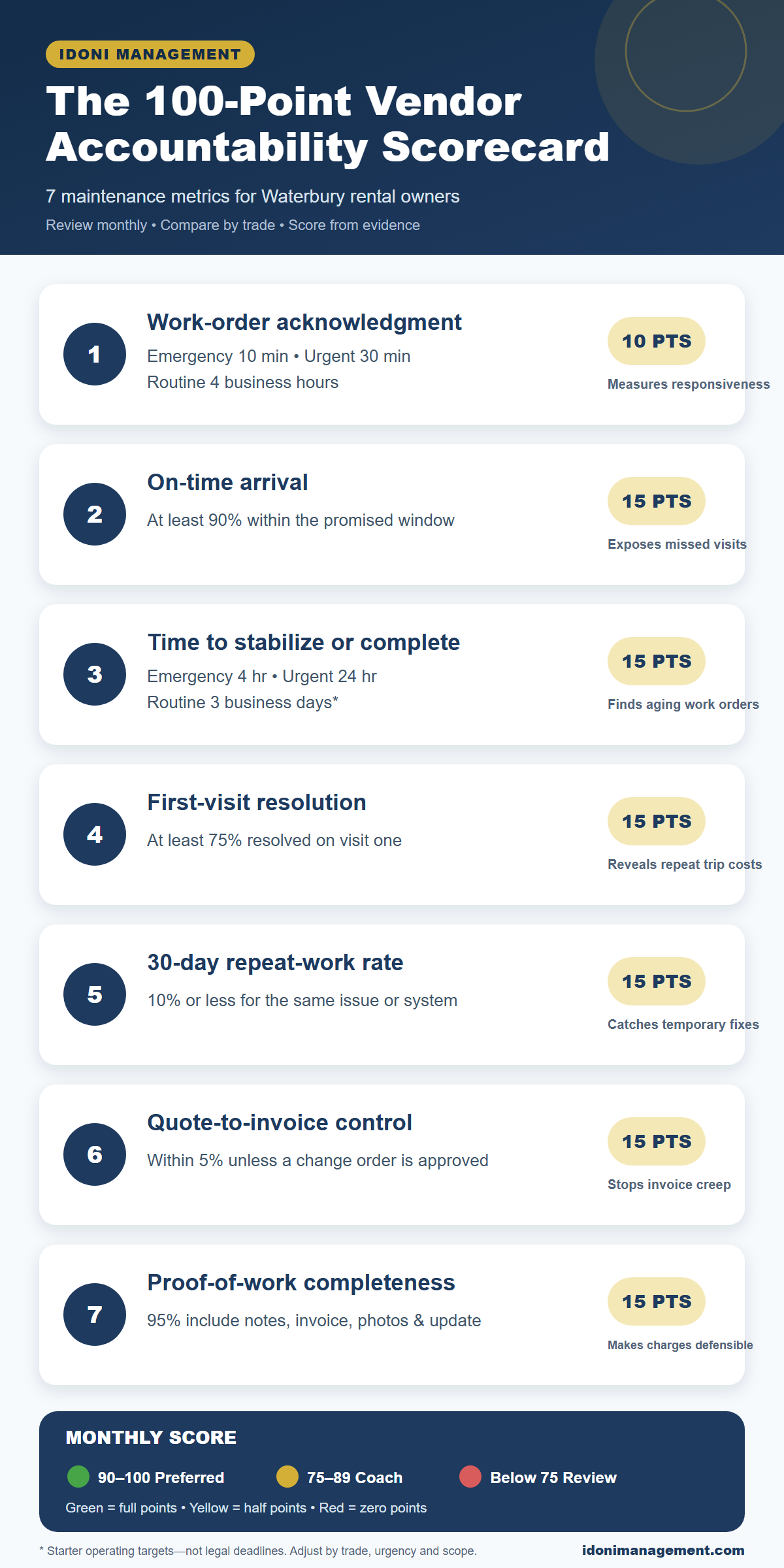
The 100-Point Waterbury Vendor Accountability Scorecard
Use this as a starting model. Adjust targets by trade, property type, business hours, access conditions, and urgency. A plumber handling active leaks should not be graded against the same completion window as a contractor ordering a custom window.
| Metric | Weight | Starter target | What it exposes |
|---|---|---|---|
| 1. Work-order acknowledgment | 10 | Emergency: 10 minutes; urgent: 30 minutes; routine: 4 business hours | Vendors who ignore assignments or force staff to chase them |
| 2. On-time arrival | 15 | At least 90% within the promised arrival window | Missed appointments, resident frustration, and wasted access coordination |
| 3. Time to stabilize or complete | 15 | Emergency stabilized within 4 hours; urgent completed within 24 hours; routine completed within 3 business days when parts are available | Slow execution and work orders that quietly age |
| 4. First-visit resolution | 15 | At least 75% resolved on the first visit | Weak diagnosis, poor preparation, or repeated trip charges |
| 5. Thirty-day repeat-work rate | 15 | 10% or less for the same issue or system | Temporary fixes and defective workmanship |
| 6. Quote-to-invoice control | 15 | Final invoice within 5% of approved quote unless a change order was approved | Scope creep, surprise charges, and weak approval controls |
| 7. Proof-of-work completeness | 15 | At least 95% of closed jobs have required notes, invoice, photos, and resident update | Charges that cannot be defended and repairs that cannot be verified |
Score each metric green, yellow, or red:
- Green: full points; target met.
- Yellow: half points; target missed narrowly or an exception was documented.
- Red: zero points; target missed materially or the file lacks evidence.
A vendor scoring 90 or higher is a preferred vendor. A score from 75 to 89 calls for coaching and closer review. Below 75 should trigger a probation period, reduced assignment volume, or replacement. Do not fire a scarce licensed trade over one bad month. Look at the pattern, the severity of the misses, and whether the vendor corrected them.
1. Measure Work-Order Acknowledgment Speed
The first clock starts when the vendor receives the assignment, not when the vendor finally arrives. Track the median number of minutes between dispatch and acknowledgment.
Acknowledgment should mean more than “got it.” The vendor should confirm whether the job is accepted, who is responding, and the expected arrival window. If a contractor repeatedly fails to accept or decline promptly, the maintenance team cannot reroute the work. The resident waits while everyone assumes somebody else owns the problem.
For emergencies, add a separate dispatch-to-contact metric: how long did it take the resident to receive confirmation that help was being coordinated?
2. Track On-Time Arrival, Not Just Whether the Vendor Eventually Came
A four-hour arrival window that is missed without notice is an operational failure even if the repair is completed later. It wastes the resident’s time, increases staff calls, and can force a paid lockbox, superintendent, or property-manager visit.
Calculate on-time arrival as:
Jobs reached within the promised window ÷ jobs with scheduled appointments × 100
Exclude resident no-shows and documented access failures, but do not let vendors hide behind vague scheduling. “Sometime tomorrow” is not a measurable appointment.
3. Separate Time to Stabilize From Time to Complete
Emergency maintenance often has two finish lines. The first is stabilization: stop the leak, restore safe heat, secure the entry, or isolate the electrical hazard. The second is permanent completion.
Track both:
- Time to stabilize: dispatch to risk controlled.
- Time to complete: dispatch to verified permanent repair.
- Aged work orders: open jobs beyond the target for their priority class.
Use the median, not only the average. Also publish the oldest five open work orders each week. A healthy average can hide one resident who has been waiting 19 days.
4. Measure First-Visit Resolution Rate
First-visit resolution is the percentage of jobs completed without another vendor trip for the same issue. It rewards diagnosis, preparation, parts planning, and trade competence.
Calculate it as:
Work orders permanently resolved on visit one ÷ work orders with an initial visit × 100
Do not penalize a vendor when a second visit was reasonably unavoidable, such as a special-order part or owner-approved phased scope. Do flag avoidable returns caused by the wrong part, an incomplete inspection, missing tools, or a repair that failed immediately.
5. Track the 30-Day Repeat-Work Rate
First-visit resolution measures trips. Repeat-work rate measures quality. Tag any new work order involving the same symptom, component, or repair area within 30 days of closure.
Calculate it as:
Repeat work orders within 30 days ÷ completed work orders × 100
A callback does not automatically prove bad workmanship. The root cause may be a failing building system, resident misuse, or an owner declining the recommended permanent repair. The scorecard should record the cause. That distinction protects good vendors while exposing recurring patchwork.
6. Control Quote-to-Invoice Variance
Owners lose money when an approved $650 job quietly becomes a $940 invoice. Compare every final invoice with the authorized amount.
Calculate variance as:
(Final invoice − approved quote) ÷ approved quote × 100
Set a written change-order rule. If concealed conditions change the scope, the vendor pauses, documents the condition, submits the added cost, and receives approval before proceeding unless immediate action is necessary to protect people or property.
Also compare the scope itself. A vendor who always stays on quote by excluding obvious finish work is not more accountable than one who sends surprise invoices.
7. Require a Complete Proof-of-Work Packet
No meaningful scorecard works without evidence. A completed work order should normally include:
- the original resident complaint;
- the assigned priority and vendor;
- appointment and access notes;
- diagnosis and work performed;
- itemized invoice;
- time-stamped before-and-after photos when photographable;
- permit, license, warranty, or inspection record when applicable;
- resident completion notice; and
- any owner approval or change order.
This documentation supports invoice review, resident disputes, warranty callbacks, security-deposit accounting, insurance claims, and future capital planning. It also extends the same discipline owners need for clean Connecticut lease records.
Waterbury Rental Market Trends in 2026
Recent Waterbury rent trackers place typical asking rents around the upper-$1,400s to roughly $1,500, while the Census-derived Connecticut rental-vacancy series was reported at 4.7% for 2025. Those broad figures are useful context, but they do not show the vacancy risk of a specific unit. A poorly documented repair, missed showing-ready date, or recurring maintenance complaint can cost an owner far more than the citywide average suggests.
Seasonality matters. Winter creates no-heat, frozen-pipe, roof, and access emergencies; spring and summer generally bring more turnover and make-ready work. Owners should review plumbing, heating, snow, electrical, and general-contracting vendor scores before peak demand, not during the emergency. Current Waterbury asking rents also mean that one avoidable vacant month can erase the savings from choosing a contractor on price alone.
Common Mistakes Connecticut Landlords Make With Maintenance Vendors
Choosing the lowest invoice instead of the lowest total cost. A cheaper first visit loses quickly when the repair requires callbacks, resident credits, or another contractor.
Using averages without showing aged work orders. A fast batch of easy jobs can hide one serious unresolved condition.
Comparing unrelated trades. An HVAC vendor, handyman, electrician, and remediation contractor need different targets and job-complexity notes.
Closing work orders on the vendor’s word alone. “Done” is not documentation. Require the note, invoice, photo, and resident update.
Ignoring resident access and owner decisions. Vendor scores should exclude documented delays the vendor did not control.
Keeping a bad vendor because the relationship is familiar. Familiarity is not performance. Good landlords use documented expectations and a fair correction process; Idoni’s guide on stronger landlord operations explains why repeatable systems matter.
Failing to verify insurance, licensing, and permits. A high score does not replace trade licensing, insurance, permit, or compliance checks.
What Connecticut Landlords Should Do Next
- Export the last 90 days of work orders and group them by vendor and trade.
- Add the seven fields above to every new work order.
- Set priority definitions for emergency, urgent, and routine requests.
- Review the scorecard monthly and the oldest open work orders weekly.
- Give vendors written targets and a chance to correct weak performance.
- Maintain at least one approved backup for every critical trade.
- Send owners a short monthly maintenance exception report, not a dump of raw work orders.
- Compare management cost with the value of controlled maintenance, documented completion, and fewer repeat repairs.
Start with data you already have. Even 20 completed jobs can reveal missed appointments, recurring callbacks, invoice drift, and missing proof. The objective is not to create a dashboard nobody reads. It is to make the next vendor decision obvious.
FAQs
What maintenance vendor metrics should a Waterbury landlord track?
Track acknowledgment speed, on-time arrival, time to stabilize and complete, first-visit resolution, 30-day repeat work, quote-to-invoice variance, and proof-of-work completeness. These seven measures cover speed, cost, quality, and documentation.
How often should landlords review vendor performance?
Review the oldest open work orders weekly and the full vendor scorecard monthly. Quarterly reviews can work for low-volume vendors, but emergencies and repeated failures should be addressed immediately.
What is a good first-visit resolution rate for property maintenance?
A 75% starter target is reasonable for mixed residential work orders, but it is not a legal or universal industry standard. Adjust the target by trade, job complexity, parts availability, and access conditions.
Should a landlord replace a vendor after one bad score?
Usually not. Review the severity, cause, and pattern. One documented exception is different from repeated no-shows, unsafe work, surprise invoices, or missing evidence. Serious licensing, insurance, safety, or integrity problems require faster action.
Does Connecticut law set a deadline for every landlord repair?
No single deadline applies to every repair. Connecticut law generally requires landlords to comply with applicable health-and-safety codes and keep premises fit and habitable. The proper response time depends on the condition and risk. Owners should get legal guidance for unresolved habitability or compliance issues.
Get a Free Waterbury Maintenance Scorecard Review
Idoni Management helps rental owners control the full maintenance chain: request intake, urgency classification, vendor dispatch, authorization, resident communication, invoice review, completion evidence, and owner reporting across Waterbury and other Connecticut markets.
Over 200 Connecticut landlords trust Idoni Management to handle their rental properties. See what owners say or request a free maintenance scorecard review for your current vendors.
This article is educational and is not legal advice. For current requirements, review Connecticut General Statutes § 47a-7 and applicable Waterbury codes, permits, and inspection requirements.