
Norwalk Lease Renewal Decision Tree: Renew, Reprice, or Replace the Resident?
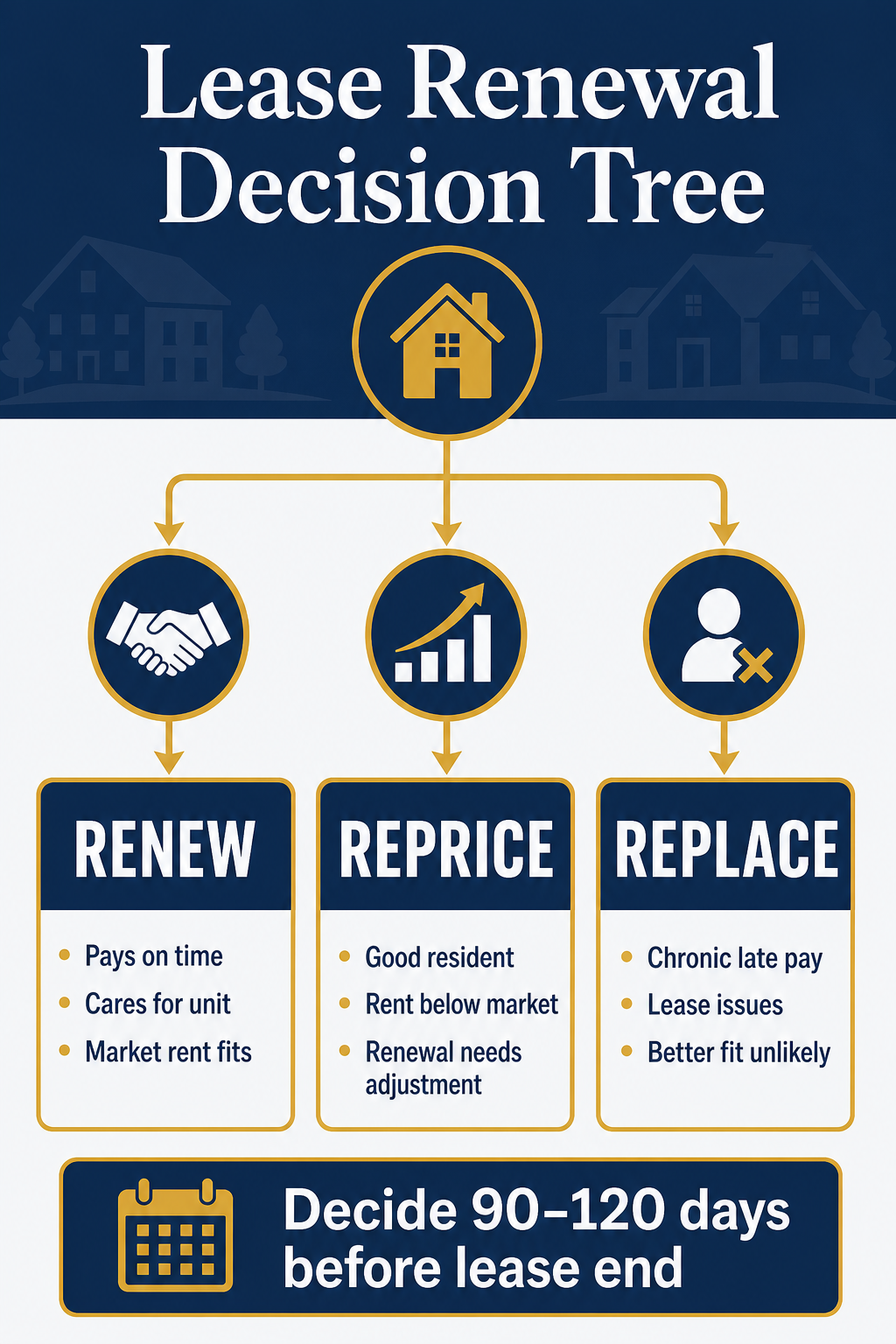
Most Norwalk lease renewals should be decided 90 to 120 days before the lease ends—not when the resident sends a last-minute text or the unit is suddenly vacant. The right question is not simply, “Can we raise the rent?” It is: Does keeping this resident produce a better outcome than turning the unit? A strong renewal protects income, avoids make-ready costs, and keeps a good resident in place. A weak renewal can lock in below-market rent, chronic friction, or another year of avoidable risk. This decision tree gives Connecticut rental owners a clean way to choose: renew, reprice, or plan a replacement.
Key Takeaways
- Start the renewal review 90 to 120 days before lease end.
- Judge the resident on payment, lease compliance, care of the home, and communication—not on one good month.
- Compare proposed rent with current Norwalk alternatives before naming a renewal number.
- Calculate turnover cost before assuming a vacancy is worth chasing a higher rent.
- Put the decision, offer, deadline, and resident response in writing.
The Renewal Question Most Owners Ask Too Late
The usual renewal process is backwards. The lease is close to expiring, somebody pulls a rent number out of thin air, and the resident is asked whether they want to stay. That is not a system. It is a coin flip with rent attached.
A better process starts with three facts:
- Is this resident worth keeping?
- Is the current rent worth keeping?
- If the answer to either is no, what is the real cost and timing of replacing them?
That is the entire decision tree. The rest is evidence.
Step 1: Score the Resident Before You Price the Renewal
Do not let “they have been here a while” become the whole argument. A long tenancy can be valuable. It can also hide slow pay, repeated lease issues, deferred maintenance reporting, and rent that has drifted too far below the market.
| Review area | Renew signal | Caution signal |
|---|---|---|
| Payment history | Rent arrives on time and in full | Repeated late payments or payment arrangements |
| Lease compliance | No material violations | Recurring unauthorized occupants, pets, smoking, or complaints |
| Unit care | Reports issues early and keeps the home reasonably clean | Damage, neglect, or preventable service calls |
| Communication | Responsive, factual, workable | Hostile, evasive, or only communicates during conflict |
| Future fit | Stable situation and realistic renewal intent | Frequent uncertainty, job/housing instability, or refusal to engage |
One late payment does not automatically mean replace. A pattern matters. Owners get into trouble when they confuse familiarity with reliability.
Step 2: Choose One of Three Paths
Renew at Market-Appropriate Rent
Choose renew when the resident is solid, the home is being cared for, and your proposed rent is reasonable against current competing inventory. A good resident is not “free.” But they are often cheaper than vacancy, painting, cleaning, marketing, showings, screening, and the risk of the next applicant.
The strongest renewal message is simple: here is the new term, here is the rent, here is the deadline to respond. No drama. No surprise terms. No thirty-email negotiation thread.
Reprice, Then Offer Renewal
Choose reprice when the resident is worth keeping but the rent needs a reset. Maybe the unit is materially below comparable Norwalk rentals. Maybe the owner absorbed a year of operating-cost increases. Maybe the renewal offer needs a modest adjustment, a different term length, or a concession that buys certainty.
The mistake is treating a rent increase as a loyalty test. It is a business decision. Your job is to explain it clearly, give the resident a fair response window, and know the vacancy math if they decline.
Before setting the number, compare true substitutes: same bedroom count, similar condition, parking, laundry, utilities, pet policy, and location. A flashy listing five blocks away is not automatically your comp.
Replace the Resident
Choose replace when the pattern says the next year will be expensive: chronic late payment, unresolved lease violations, serious care concerns, repeated conflict, or a unit that needs a genuine repositioning. Replacement is not revenge. It is a controlled business call.
If you choose this path, do it early. Confirm the lease terms, notice requirements, likely make-ready scope, pricing, photography, listing copy, showing plan, and lead-response ownership before the resident leaves. Vacancy hurts most when the owner decides too late and starts from zero.
The Turnover Math That Changes the Answer
“We can get more rent” is not enough. Put the expected gain next to the cost of creating it.
| Decision | Direct upside | Cost to include before deciding |
|---|---|---|
| Renew | Keeps income flowing; avoids a turn | Any discount or concession needed to retain a strong resident |
| Reprice | Closes a rent gap while keeping the resident | Risk of non-renewal; a realistic fallback plan |
| Replace | Opportunity to reset rent and resident fit | Lost rent, utilities, cleaning, repairs, marketing, leasing, and days vacant |
If a $150 monthly increase creates one extra month of vacancy plus a turn, the “increase” may be a bad trade. If a resident is consistently late, noncompliant, and consuming staff time, a below-market renewal may be even worse.
The answer is not emotional. It is a simple annualized comparison.
Norwalk Rental Market Trends: Use Today’s Competition, Not Last Year’s Memory
Norwalk is not one rental market. A renewed lease should be checked against the current choices a resident will actually compare: nearby units, condition, parking, laundry, outdoor space, access to transit, and included utilities. New listings, seasonality, and the number of similar homes available can change the practical renewal number fast.
That is why a renewal workflow needs a fresh comp review close to the decision date. Use current inventory to set a credible offer. Then keep a record of the rationale. A documented decision is easier to explain to an owner and easier to repeat across a portfolio.
For a broader operating view, see Idoni’s guidance on what a property manager should actually handle—renewals are not an administrative afterthought.
Common Mistakes Connecticut Landlords Make With Lease Renewals
Waiting until the final month. Late decisions turn a manageable renewal into an urgent vacancy problem.
Using only a rent comp. A rent number without resident quality and turnover cost is incomplete.
Giving different answers to different people. If the owner, leasing agent, and resident do not see the same plan, the renewal drifts.
Raising rent without a fallback plan. Every offer should include the “what if they decline?” operating plan.
Forgetting the paper trail. Renewal terms, notice dates, resident responses, and approved pricing should be documented. The same discipline that protects a lease also supports better Connecticut lease documentation.
What Connecticut Landlords Should Do Next
- Create a 120-day renewal report for every lease ending this quarter.
- Grade payment, compliance, unit care, and communication from the full lease term.
- Run current comps before setting a number.
- Calculate the cost of a realistic turnover—not a fantasy one-week flip.
- Send one written offer with a clear response deadline.
- If replacement is likely, start the make-ready and lease-up plan before possession.
Owners dealing with a broader resident-performance issue should also keep their screening criteria consistent. The best renewal problem is the one you prevented at move-in.
FAQs
How early should a Norwalk landlord start a lease renewal?
Start the review 90 to 120 days before lease end. That gives time to assess the resident, check current competition, make an offer, and prepare a lease-up plan if the resident declines.
Should a landlord renew a lease with a good resident below market rent?
Often, yes—if the rent gap is smaller than the likely turnover cost and the resident is reliable. The decision should be based on real vacancy and make-ready costs, not only the advertised rent of another unit.
How much should rent increase at renewal in Norwalk?
There is no single safe number. Use current comparable rentals, the property’s condition, utilities, amenities, and the resident’s retention value. A modest, supportable adjustment can outperform an aggressive increase that produces vacancy.
What if a resident does not answer a renewal offer?
Follow the lease and applicable notice rules, send a documented deadline, and begin a contingency lease-up plan. Do not wait until the final week to discover the resident is leaving.
Get a Renewal Decision Review
Idoni Management helps Connecticut owners turn renewal dates into controlled operating decisions: resident history, current pricing, documented communication, and a lease-up fallback if the answer is no. If you want a second set of eyes before an avoidable vacancy, request a renewal decision review.