

Why Connecticut Rental Owners Feel Like ATMs With Traditional Property Management
Traditional property management often puts Connecticut rental owners in the worst possible position: financially responsible for every decision, but under-informed about what is actually happening. The owner gets the repair invoice, the vacancy loss, the leasing delay, and the late-night worry, but not always the context behind those outcomes. That is why many owners start to feel like ATMs. Money keeps leaving the account, yet visibility is thin.
The real problem is not that maintenance exists or leasing takes work. Those are normal parts of owning rentals. The problem is surprise repair bills, vague owner updates, slow leasing reports, and poor tracking between tenant issues, vendor work, rental leads, and follow-up. Idoni Management solves that problem with owner visibility systems: automated updates, lead tracking, maintenance workflows, and AI-assisted follow-up designed to reduce chaos and keep Connecticut rental owners informed before small issues become expensive mysteries.
Key Takeaways
- Many rental owners feel frustrated because they own the asset but are often the last person to know what is happening.
- Surprise repair bills usually come from weak maintenance workflows, poor documentation, or delayed approval communication.
- Leasing delays become more expensive when owners cannot see lead volume, showing activity, application status, and follow-up speed.
- Owner reporting should explain what happened, what changed, what is pending, and what decision is needed next.
- Idoni uses automated visibility, tracked leasing pipelines, maintenance workflows, and AI-assisted follow-up to keep owners out of the dark.
- A free owner visibility audit can show where your current management process is creating confusion, delay, or unnecessary cost.
Why Traditional Property Management Feels So Opaque
Most rental owners do not expect perfection. They know tenants call about repairs. They know vendors cost money. They know vacancies happen.
What they cannot accept is being left guessing.
| Owner Pain | What It Feels Like | What Should Happen Instead |
|---|---|---|
| Surprise repairs | “Why am I seeing this charge now?” | Documented issue, vendor notes, approval trail, invoice context |
| Vague updates | “Everything is fine” until it is not | Clear status by property, tenant, maintenance, and leasing activity |
| Slow leasing reports | “Is anyone even showing the unit?” | Lead counts, showing activity, application stage, follow-up tracking |
| Poor follow-up | “I had to ask three times” | Automated owner updates and task-based accountability |
| No visibility | “I own the property, but I am not in the loop” | Owner-facing systems that show what is moving and what is stuck |
This is where property management breaks trust. The owner is not upset because a toilet needed a repair. The owner is upset because the repair appeared as a charge with no useful story around it.
If you are also reviewing lease or documentation risk, Idoni’s guide to Connecticut lease documentation is a useful companion piece.
The Real Cost of Being the Last Person to Know
A lack of visibility does not just feel bad. It costs money.
For Connecticut landlords, poor communication can create real operational drag:
- Repairs sit too long and become bigger repairs.
- Tenants get frustrated because nobody follows up clearly.
- Vacant units lose days because leasing activity is not tracked tightly.
- Owners approve work without enough context.
- Managers react to problems instead of running a repeatable process.
- Renewal, screening, and maintenance decisions happen without a clean record.
This is the emotional center of the issue: “I own the asset, but I am the last person to know what is going on.”
That should never be the standard. A rental owner should not have to chase basic answers like how many leads came in, how many showings happened, why an applicant stalled, which maintenance requests are open, which vendor is assigned, and what is waiting on the tenant, owner, vendor, or manager.
How Idoni Builds Owner Visibility Into the System
Idoni Management’s wedge is simple: owners should not have to beg for operational visibility.
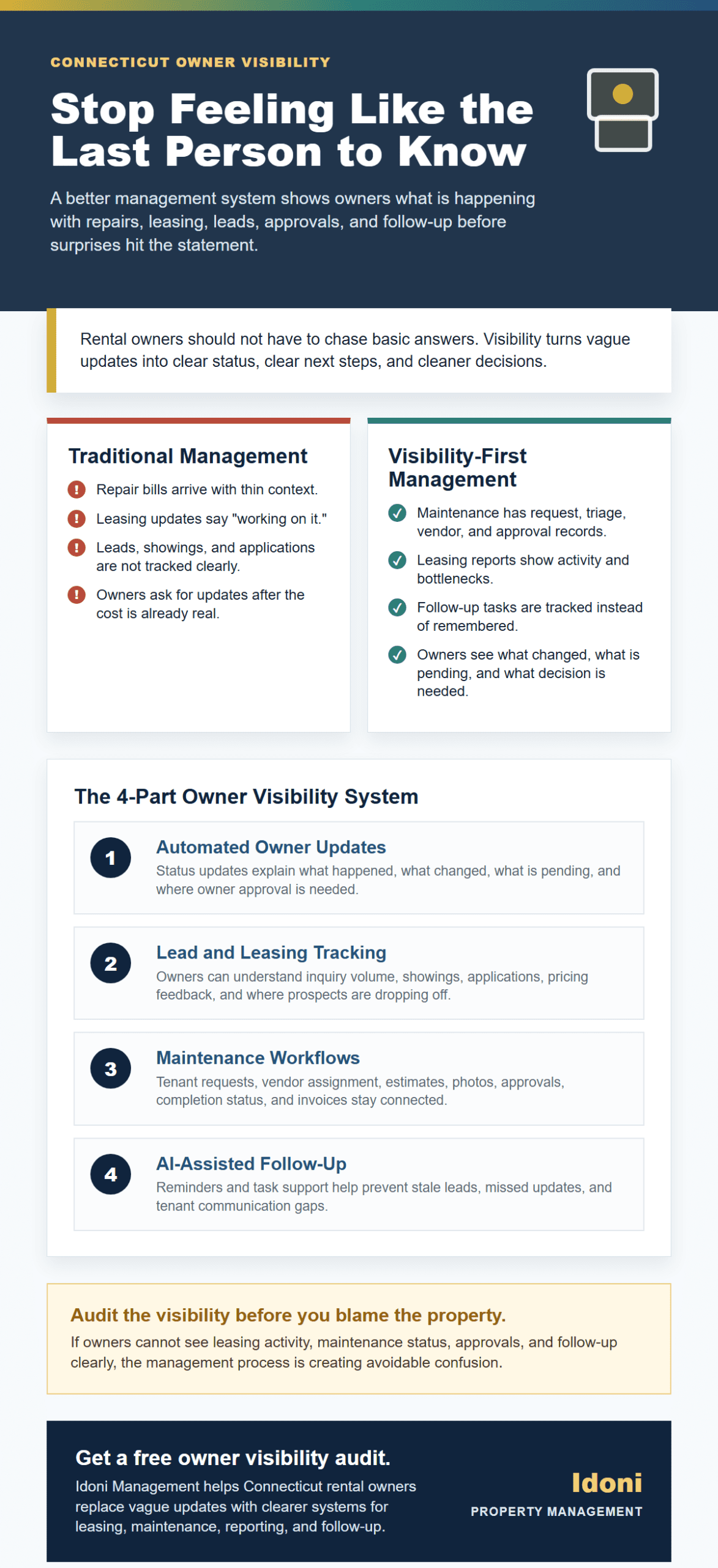
That requires systems, not just promises. Idoni uses automated owner visibility, lead tracking, maintenance workflows, and AI-assisted follow-up to make sure important activity does not disappear into scattered texts, inboxes, and vendor calls.
Automated Owner Visibility
Owner updates should be structured enough to answer the real questions: what happened, what changed, what is pending, what decision is needed, and what cost, risk, or timeline the owner should understand.
Automated visibility does not mean cold, robotic updates. It means the system captures activity consistently so the owner is not dependent on someone remembering to send a status note at the end of a busy day.
Lead Tracking for Leasing
Vacancy is one of the fastest ways a rental property loses money. That makes leasing visibility critical.
Idoni tracks leasing activity so owners can understand inquiry volume, showing activity, prospect follow-up, application status, pricing feedback, days on market, and where the leasing process is slowing down.
This matters because a unit with no applications needs a different response than a unit with strong lead volume but poor showing conversion. Without tracking, owners just hear “we are working on it.” That is not enough.
For owners thinking through screening quality, Idoni’s article on tenant screening in Bridgeport explains why process matters before a lease is signed.
Maintenance Workflows
Maintenance is where owners often feel most like ATMs.
A better workflow connects the tenant request, triage notes, vendor assignment, estimate or approval threshold, photos or documentation when available, completion status, invoice review, and owner update.
The goal is not to eliminate repair costs. That is impossible. The goal is to eliminate confusion around repair costs. Connecticut rental properties age, weather hits hard, and mechanical systems fail. Owners need a management process that documents the why behind the spend.
AI-Assisted Follow-Up
AI-assisted follow-up helps reduce dropped balls. It can help organize reminders, draft status updates, flag stale leads, and support faster communication.
The important part: AI should support management discipline, not replace judgment. Idoni uses it to help keep follow-up moving so owners and tenants are not stuck waiting on preventable delays.
Connecticut Rental Market Trends Owners Should Watch
Connecticut rental demand can vary sharply by city, season, price point, and property condition. Bridgeport, New Haven, Hartford, Waterbury, Stamford, and surrounding towns do not all behave the same, so owners should watch property-level leasing data instead of relying only on broad market averages.
For owner visibility, the most useful trends are practical: lead volume, days on market, showing-to-application conversion, renewal interest, maintenance frequency, and rent feedback from qualified prospects. Spring and late summer often bring stronger leasing activity, while slower winter periods can expose weak pricing, poor listing presentation, or slow follow-up.
Common Mistakes Connecticut Landlords Make With Property Management Visibility
- Accepting vague owner statements: “Everything is fine” is not a report. Owners need specifics. If a manager cannot explain leasing, maintenance, collections, and tenant issues clearly, the owner is carrying unnecessary risk.
- Looking only at the monthly statement: The monthly statement tells you what happened financially. It does not always tell you why it happened operationally. Good management connects the numbers to activity.
- Waiting until a vacancy gets expensive: If a unit sits, the owner needs to know whether the issue is pricing, photos, condition, showing access, lead quality, or follow-up speed. Waiting three weeks to diagnose the problem is expensive.
- Treating maintenance as just an invoice: Maintenance should create a record. Owners should know what was requested, how it was triaged, who handled it, what was approved, and whether there are repeat issues.
- Hiring for low fees instead of operational control: Cheap management gets expensive when the owner has to chase updates, question invoices, and manage the manager. Fee structure matters, but visibility matters more. Idoni’s breakdown of what property managers actually provide can help owners compare service models more carefully.
What Connecticut Landlords Should Do Next
Before switching property managers or renewing with your current one, review your visibility gaps.
- Can you see leasing activity before the unit sits too long?
- Do maintenance invoices come with enough context?
- Are owner updates proactive or only sent when you ask?
- Can your manager explain what is pending by property?
- Are tenant issues documented in a repeatable workflow?
- Are leads and follow-ups tracked, or handled informally?
- Do you know which problems are urgent, delayed, or waiting on approval?
If the answer is mostly no, the issue is not just communication style. It is an operating system problem.
FAQs
Why do rental owners feel like ATMs with traditional property management?
Because they are often asked to fund repairs, vacancies, and vendor work without enough visibility into the decisions behind those costs. The frustration comes from paying the bills while lacking clear operational context.
What should a property manager report to owners?
Owners should receive clear updates on leasing activity, maintenance status, rent collection, tenant issues, upcoming renewals, major expenses, and decisions that need approval. The report should explain both status and next steps.
How can lead tracking help Connecticut rental owners?
Lead tracking shows whether a vacancy problem is caused by low demand, weak pricing, poor listing quality, slow follow-up, or application friction. Without it, owners cannot tell whether the leasing process is working.
Does AI replace a property manager?
No. AI should support follow-up, reminders, drafting, organization, and visibility. Property management still requires local judgment, vendor coordination, tenant communication, and owner-level decision-making.
What is an owner visibility audit?
An owner visibility audit reviews how clearly a rental owner can see leasing, maintenance, tenant communication, approvals, reporting, and follow-up. It identifies where the current process creates confusion, delay, or surprise costs.
How Idoni Management Can Help
Idoni Management helps Connecticut rental owners stop operating in the dark. We handle leasing visibility, maintenance coordination, owner reporting, tenant follow-up, and documented workflows for landlords across Bridgeport, Hartford, Waterbury, New Haven, and surrounding Connecticut markets.
Over 200 Connecticut landlords trust Idoni Management to handle their rental properties. See what they say or get your free owner visibility audit today.