
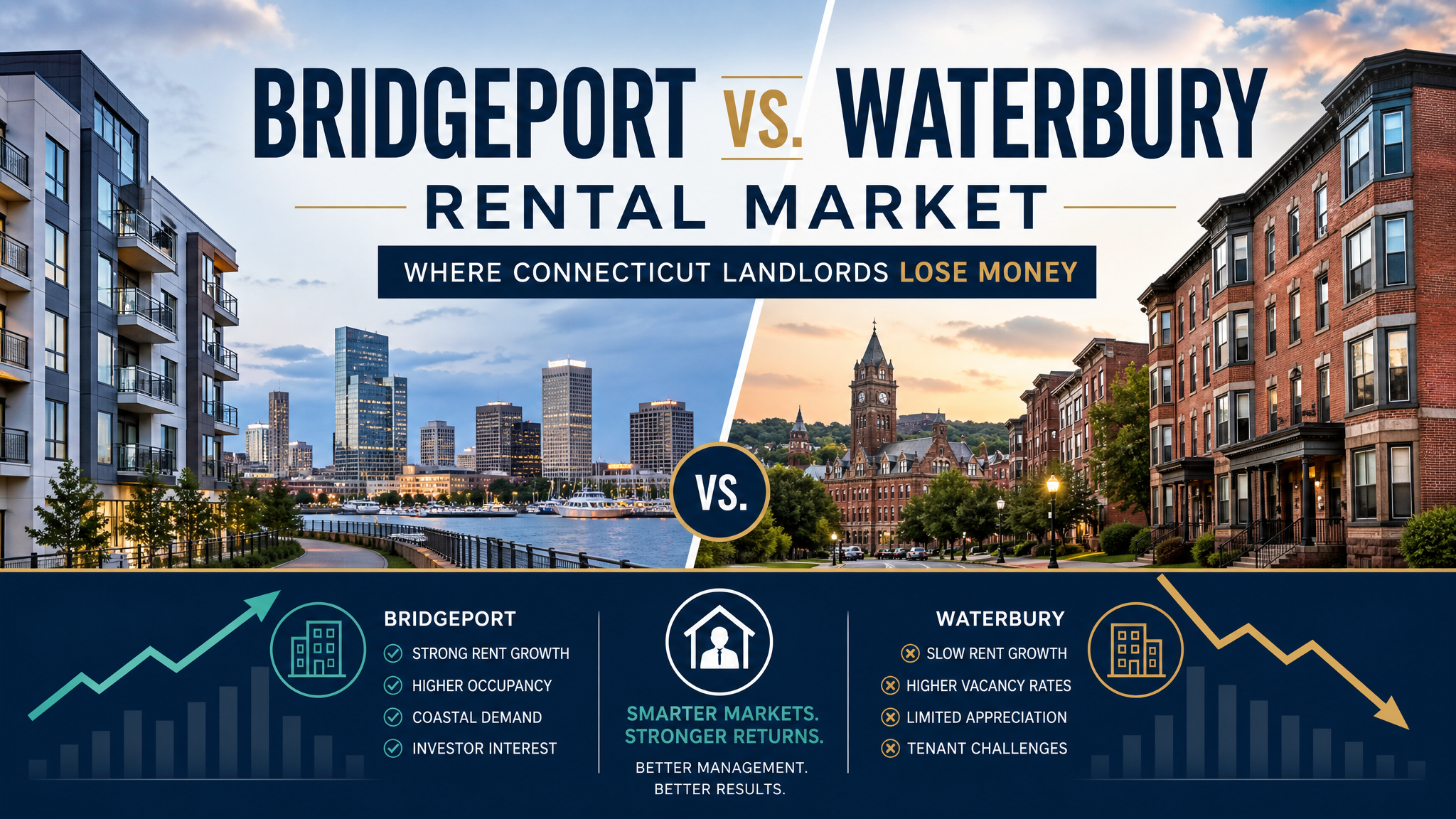
Bridgeport vs. Waterbury Rental Market: Where Connecticut Landlords Lose Money
Bridgeport and Waterbury can both work for Connecticut rental owners, but they do not fail in the same way. Bridgeport usually gives landlords stronger tenant depth, higher median gross rent, and a larger renter base. Waterbury can offer lower acquisition costs and solid rental demand, but owners often have to manage more price sensitivity, older housing issues, and slower leasing friction if the unit is not positioned correctly. The mistake is treating both cities like the same market. A Bridgeport rental may lose money because the owner underprices, moves too slowly, or wastes strong demand. A Waterbury rental may lose money because the owner overestimates rent, ignores condition problems, or fails to screen carefully. The right property management system should adjust pricing, leasing speed, tenant qualification, maintenance planning, and owner reporting city by city.
Key Takeaways
- Bridgeport has a larger renter base: ACS 2024 1-year data shows about 32,232 renter-occupied units, compared with about 23,623 in Waterbury.
- Median gross rent is higher in Bridgeport: about $1,563 compared with about $1,305 in Waterbury, according to ACS 2024 1-year data.
- Waterbury shows more for-rent vacancy in ACS 2024 5-year estimates: about 1,724 units for rent versus about 907 in Bridgeport.
- Both markets have serious renter affordability pressure, which makes screening and rent positioning more important, not less.
- Bridgeport owners often lose money through slow response and weak leasing systems. Waterbury owners often lose money through condition issues, overpricing, and poor qualification.
- The best strategy is not simply “raise rent.” It is tighter pricing, faster lead handling, stronger documentation, and cleaner owner visibility.
Quick Market Snapshot: Bridgeport vs. Waterbury
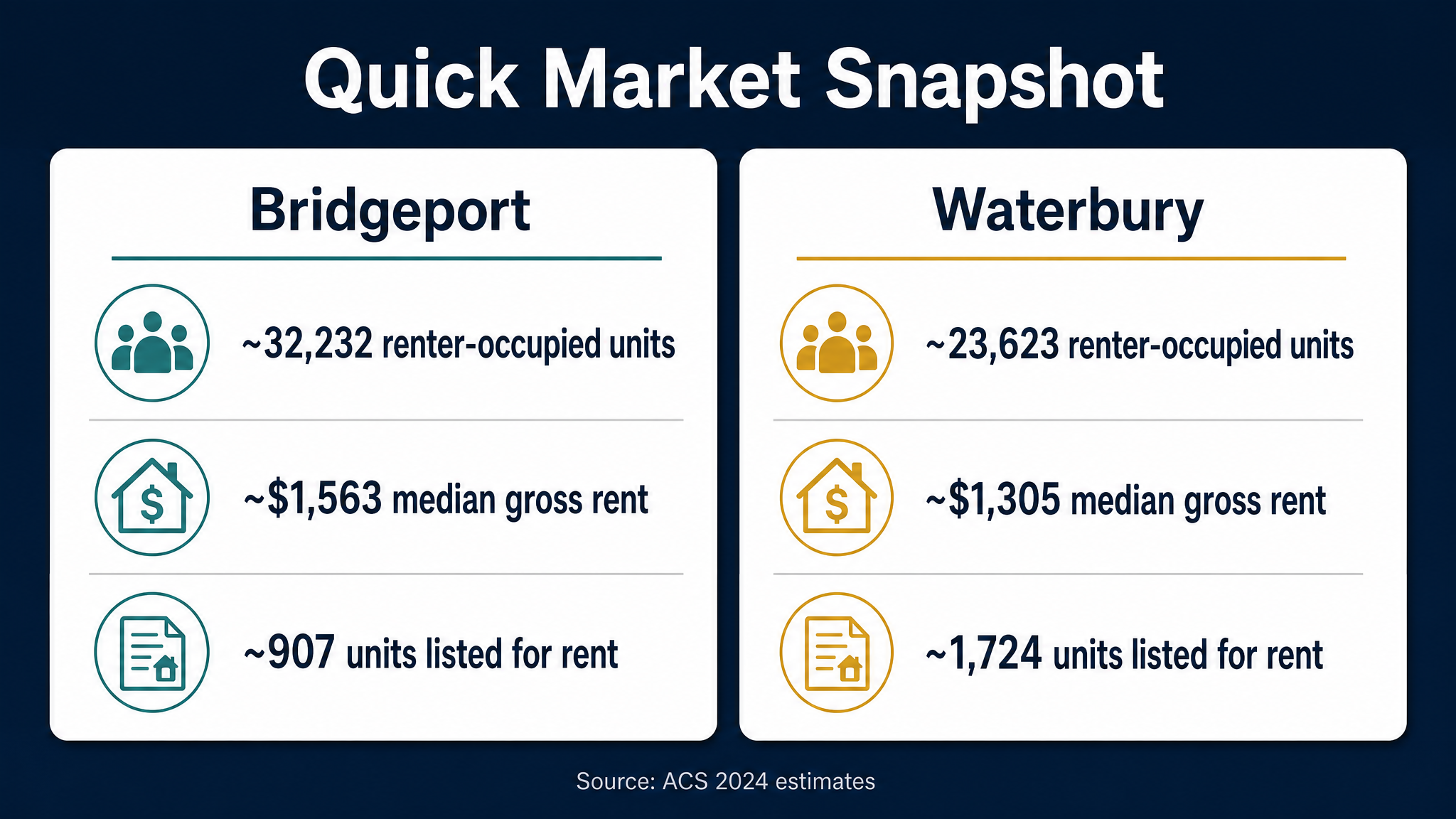
The numbers do not tell the whole story, but they do show why the two markets need different operating plans.
| Market | Renter-Occupied Units | Median Gross Rent | Estimated Units Listed “For Rent” | What This Means for Owners |
|---|---|---|---|---|
| Bridgeport | ~32,232 | ~$1,563 | ~907 | Larger renter base, stronger rent ceiling, but owners can lose good applicants if the leasing process is slow. |
| Waterbury | ~23,623 | ~$1,305 | ~1,724 | Lower median rent and more visible rental supply, so pricing and property condition matter heavily. |
Source note: Figures above use Census Reporter / U.S. Census ACS 2024 1-year data for tenure and median gross rent, and ACS 2024 5-year data for vacancy status.
The operating lesson is simple: Bridgeport rewards speed and lead discipline. Waterbury rewards price accuracy, condition control, and screening discipline.
Where Bridgeport Landlords Lose Time and Money
Bridgeport is not a sleepy rental market. It has a large renter population, proximity to Fairfield County employment, commuter access, and a wide mix of multifamily housing. That can be good for landlords.
But it also creates a trap.
When demand exists, some owners assume leasing will take care of itself. It does not.
Bridgeport landlords often lose money in five places:
- slow response to new rental inquiries
- weak prescreening before showings
- underpriced renewals because the owner is afraid of vacancy
- inconsistent maintenance follow-up in older multifamily buildings
- poor documentation when tenant issues start building
A Bridgeport rental can have plenty of interest and still underperform if the owner does not have a clean system for converting interest into qualified applicants.
This is where Idoni’s perspective matters. Property management should not depend on inbox luck. It should run on a repeatable process: fast response, structured prescreening, documented follow-up, clear owner reporting, and consistent renewal review.
For owners dealing with tenant quality issues, Idoni’s guide to tenant screening in Bridgeport is a useful companion to this market analysis.
Where Waterbury Landlords Lose Time and Money
Waterbury has a different risk profile.
The city can make sense for investors who want more accessible acquisition prices and steady renter demand. But Waterbury owners cannot assume every unit will lease quickly just because the rent seems affordable compared with coastal Connecticut.
Waterbury rentals can drag when:
- asking rent is above what the local applicant pool can support
- the unit photographs poorly
- repairs are deferred before listing
- the owner waits too long to adjust pricing
- applicants are not screened consistently
- older building issues create inspection, safety, or habitability risk
Waterbury is a market where small operational misses show up fast. A unit that is a little overpriced, a little tired, and a little slow to respond can sit longer than expected.
That does not mean Waterbury is a bad rental market. It means owners need discipline. The rent has to match the product. The product has to match the photos. The photos have to match the showing. The screening process has to protect the owner from forcing a bad tenancy just to end vacancy.
Rent Burden Matters in Both Markets
One of the most important signals in both Bridgeport and Waterbury is renter affordability pressure.
ACS 2024 data shows many renters in both cities spend 30% or more of household income on gross rent. Among renter households where rent burden is computed, Bridgeport is roughly in the mid-60% range, and Waterbury is roughly around 70%.
That matters for landlords because affordability pressure changes the risk profile.
It can lead to:
- more applicants who look interested but cannot qualify
- more pressure around security deposits and move-in funds
- more payment-plan requests
- more turnover risk if rents are pushed too aggressively
- more importance on clear lease documentation and communication
This is why pricing cannot be emotional. If rent is too low, the owner leaves income on the table. If rent is too high, the owner may create vacancy, attract weaker applicants, or lose qualified renters to better-positioned units.
Security deposit handling also matters in both cities. Connecticut has strict rules on deposit limits, handling, interest, and returns. Owners should review Idoni’s guide to Connecticut security deposits before the next turnover.
Bridgeport vs. Waterbury: Different Leasing Strategies
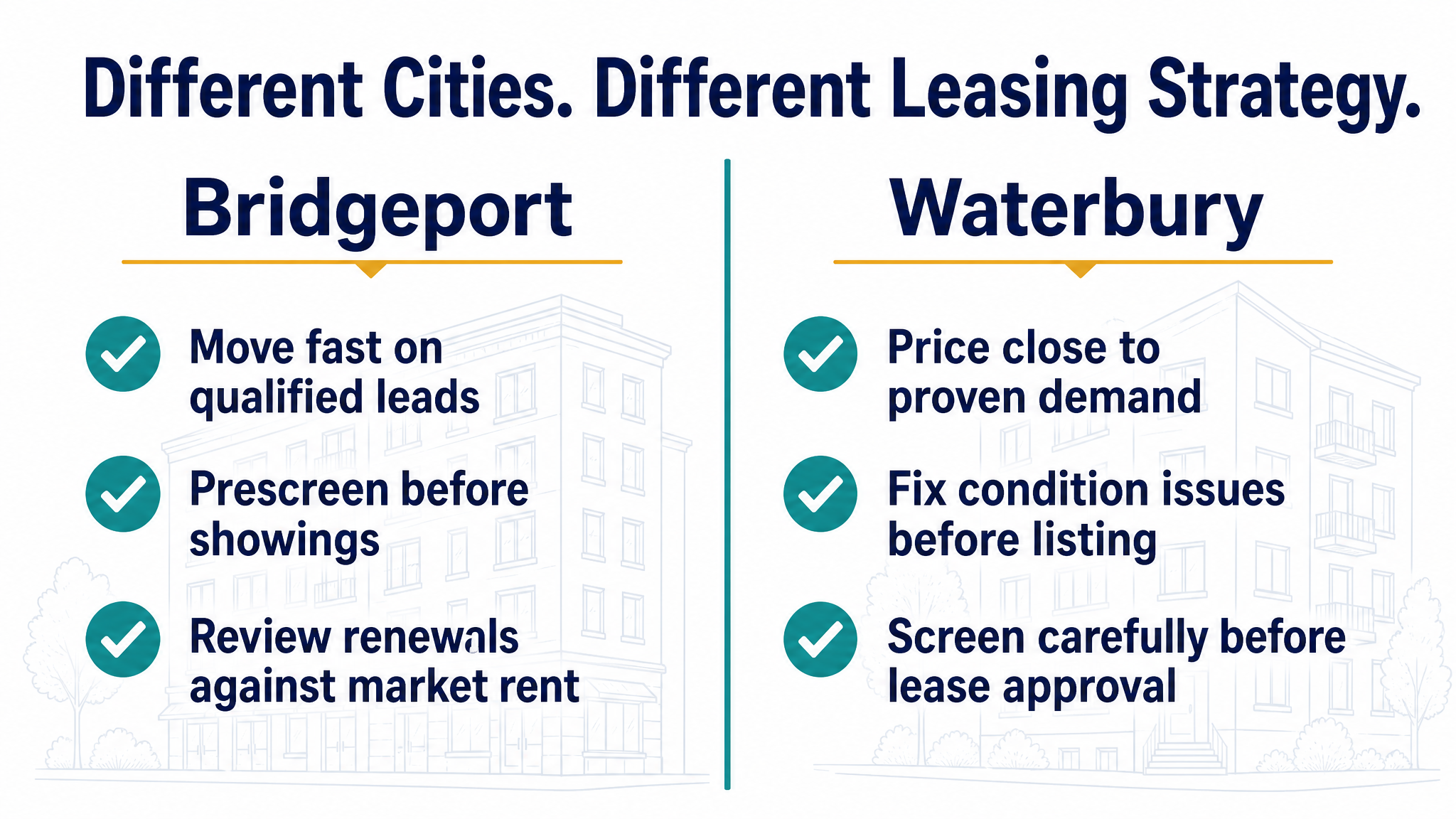
Owners should not use the same leasing strategy in both markets.
| Leasing Decision | Bridgeport Strategy | Waterbury Strategy |
|---|---|---|
| Pricing | Test the upper range carefully, but watch response quality fast. | Price close to the proven market, then adjust quickly if leads are weak. |
| Lead response | Speed is critical because good prospects have options. | Speed still matters, but qualification and fit matter even more. |
| Showings | Prescreen first to avoid wasted appointments. | Prescreen hard before spending staff time. |
| Photos | Strong photos help the unit stand out in a competitive city. | Strong photos are essential if condition is only average. |
| Maintenance | Older multifamily issues need proactive tracking. | Condition problems can kill rent expectations quickly. |
| Renewals | Review market rent before defaulting to small increases. | Avoid rent jumps that create turnover unless the unit can support them. |
The owner who wins in either market is usually not the owner with the most optimistic rent estimate. It is the owner with the cleanest operating system.
The Local Market Trends Connecticut Owners Should Watch
Bridgeport and Waterbury landlords should pay attention to several trends in 2026:
- Applicant quality matters more than raw lead volume.
A listing can generate inquiries and still fail if the inquiries are not qualified. That is especially true when renters are stretched by affordability pressure.
- Older housing stock requires tighter maintenance systems.
Both Bridgeport and Waterbury have many older multifamily properties. Deferred maintenance can become a leasing problem, a tenant satisfaction problem, and eventually a compliance problem.
- Local compliance is getting harder to ignore.
Owners should not treat compliance as something to check only after a complaint. Rental registration, smoke and carbon monoxide safety, lead paint issues, lease language, and documentation can all become expensive if ignored. Idoni’s annual compliance checklist for Connecticut landlords covers the basics owners should review.
- Leasing speed is becoming a management advantage.
Fast response, structured prescreening, and clean next steps help owners convert qualified renters before they move on. That is why Idoni uses systems and automation in the front end of leasing instead of relying only on manual follow-up.
- Owner visibility is becoming a differentiator.
Owners do not just want a tenant placed. They want to know what is happening, why the unit is or is not moving, what the pricing data says, and what action is being taken.
Common Mistakes Connecticut Landlords Make in Bridgeport and Waterbury
The biggest mistake is assuming these markets are interchangeable.
Other common mistakes include:
- using one rent estimate without checking actual lead quality
- waiting too long to adjust rent after weak showing activity
- showing units to unqualified prospects
- listing before repairs, cleaning, and photos are ready
- accepting a weak tenant to avoid one more month of vacancy
- failing to document lease violations early
- ignoring local inspection, safety, or registration requirements
- measuring property performance only by rent, not by net operating results
Owners also get into trouble when they focus only on leasing and ignore the rest of the system. A rental that leases fast but creates maintenance chaos, late payments, and turnover is not really performing.
If tenant problems have already escalated, owners should also understand the Connecticut eviction process before taking action.
What Connecticut Landlords Should Do Next
If you own in Bridgeport, Waterbury, or nearby Connecticut markets, run a simple market performance review before your next vacancy or renewal.
Use this checklist:
- Compare your current rent against real competing listings, not wishful estimates.
- Review how fast new leads get a response.
- Prescreen before scheduling showings.
- Look at how many leads become showings, applications, and approved tenants.
- Check whether the unit condition supports the rent you want.
- Review lease documents, security deposit practices, and notices.
- Track maintenance issues that could affect renewal or compliance.
- Decide in advance when you will adjust price if activity is weak.
The goal is not just to rent the unit. The goal is to protect net income.
A good property manager should be able to explain the market, the leasing process, the tenant qualification standards, the maintenance plan, and the owner reporting system. If the answer is basically “we put it online and wait,” that is not a system.
FAQs
Is Bridgeport or Waterbury better for rental property investors?
Neither city is automatically better. Bridgeport generally has a larger renter base and higher median gross rent, while Waterbury may offer lower acquisition costs and steady demand. The better market depends on purchase price, property condition, rent positioning, tenant quality, and management discipline.
Why do Waterbury rentals sometimes sit longer than expected?
Waterbury rentals often sit when the rent is too aggressive for the unit condition, photos are weak, repairs are unfinished, or the owner is attracting applicants who cannot qualify. Price accuracy and prescreening are especially important.
Why do Bridgeport landlords lose good applicants?
Bridgeport owners can lose good applicants when response time is slow, the showing process is disorganized, or the unit is not ready when leads arrive. In a larger renter market, speed and follow-up can make a major difference.
How should Connecticut landlords compare rents between cities?
Do not compare cities only by asking rent. Compare actual lead quality, days on market, unit condition, concessions, applicant income, renewal risk, and expected maintenance costs. Net performance matters more than the highest advertised rent.
Should I hire a property manager for a Bridgeport or Waterbury rental?
A property manager can help if you are losing time on leasing, tenant communication, maintenance coordination, compliance, or rent collection. The key is choosing a manager with a repeatable system, not just someone who reacts when problems happen.
How Idoni Management Can Help
Idoni Management helps Connecticut rental owners run properties with better systems: faster leasing response, structured prescreening, clearer tenant communication, organized maintenance follow-up, and owner visibility.
Over 200 Connecticut landlords have trusted Idoni Management with leasing, operations, and property management support across local rental markets.
If you own in Bridgeport, Waterbury, or a nearby market, we can review your rental’s pricing, leasing workflow, condition risks, and management gaps before they turn into lost income.