

The 2026 Connecticut Eviction Timeline & Checklist
Evicting a tenant in Connecticut takes an average of 45 to 60 days, but a single paperwork mistake can force you to start over. For property owners in cities like Bridgeport, Waterbury, and Hartford, navigating the state’s strict Notice to Quit requirements and Superior Court backlog is the biggest risk to rental income. This guide provides the exact 2026 timeline and checklist you need to legally regain possession of your property without costly delays.
Watch this official guide from the Connecticut Judicial Branch explaining the eviction process:
Key Takeaways
- Notice to Quit: Must give at least 3 full days’ notice (excluding the day served, move-out day, Sundays, and holidays).
- Summons and Complaint: Filed in Superior Court only after the Notice to Quit expires.
- Appearance Deadline: Tenants have 2 days after the return date to file an Appearance.
- Execution of Eviction: If you win, tenants have 5 days to move before a State Marshal can physically remove them.
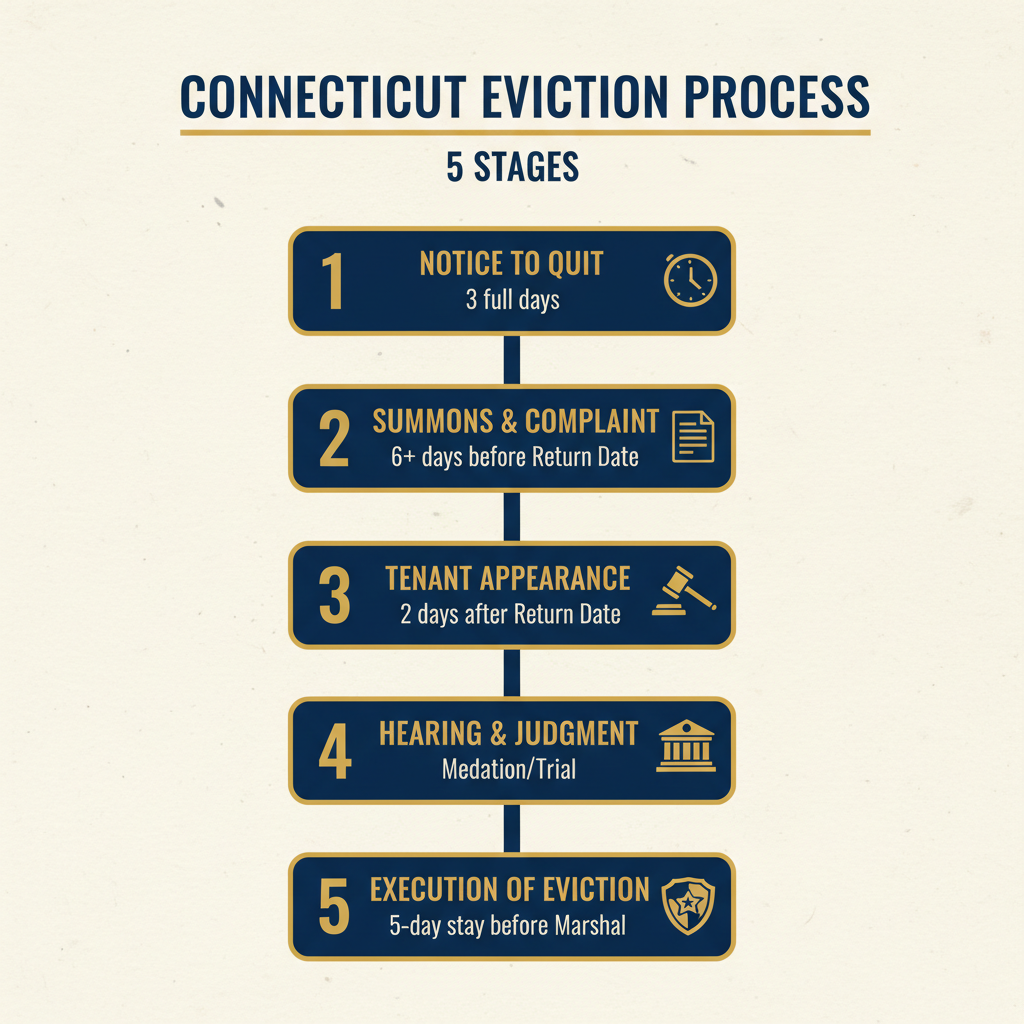
Step 1: Serve the Notice to Quit
The eviction process (Summary Process) strictly begins with the Notice to Quit (NTQ). This is a formal legal document telling the tenant they must leave by a specific date.
In Connecticut, you must provide a minimum of 3 full days of notice for non-payment of rent or lease violations. However, calculating these three days is where most landlords fail:
- You cannot count the day the notice is served.
- You cannot count the deadline day.
- You cannot count Sundays or state legal holidays.
If your lease requires a longer notice period (e.g., 5 or 10 days), you must honor the lease. The NTQ must be served properly, ideally by a State Marshal, to ensure the court accepts the proof of service.
Step 2: File the Summons and Complaint
If the tenant remains in the property after the Notice to Quit expires, you must file a Summons and Complaint with the local housing court.
This paperwork officially starts the lawsuit. The court will set a “Return Date,” which is the deadline for the tenant to respond to your complaint. A State Marshal must serve the Summons and Complaint to the tenant at least 6 days before the Return Date.
Step 3: Tenant’s Appearance and Pleading
Once served, the tenant has until two days after the Return Date to file an “Appearance” (a form stating they are participating in the case).
If the tenant fails to file an Appearance, you can file a Motion for Default Judgment, which speeds up the eviction. If the tenant does file an Appearance, they may also file an Answer or special defenses, which will lead to a court hearing.
Step 4: The Court Hearing or Mediation
If the tenant fights the eviction, the court will schedule a hearing. In Connecticut housing courts, cases often go to mediation first. A court mediator will try to help you and the tenant reach an agreement (a “Stipulated Judgment”) outlining when they will leave or how they will pay back rent.
If mediation fails, you go before the judge. You must bring all evidence: the lease, the payment ledger, communications, and the Notice to Quit with the Marshal’s return of service.
Step 5: Judgment and Execution
If the judge rules in your favor (or if the tenant defaults), the court issues a Judgment for Possession.
However, Connecticut law gives the tenant a mandatory 5-day stay of execution (a grace period to move out). If they do not leave after 5 days, you must apply for a Summary Process Execution for Possession. Once issued, a State Marshal will serve the execution, giving the tenant a final 24 hours to vacate before physical removal.
Common Mistakes Connecticut Landlords Make With Evictions
- Miscalculating the 3-Day Notice: Counting Sundays or the day of service invalidates the entire eviction.
- Accepting Partial Rent: If you accept any rent after serving the Notice to Quit, the court may rule you reinstated the lease.
- Self-Help Evictions: Changing locks, shutting off utilities, or removing tenant property is illegal in Connecticut and carries severe financial penalties.
- Using the Wrong Forms: Using generic online forms instead of the specific JD-HM forms required by the Connecticut Judicial Branch.
What Connecticut Landlords Should Do Next
- Audit your lease: Ensure your lease documentation clearly defines grace periods and termination clauses.
- Stop taking partial payments: If a tenant is significantly behind, do not accept a partial payment if you intend to evict.
- Hire a Marshal early: Do not try to serve the Notice to Quit yourself. Use a professional to guarantee a clean paper trail.
- Act immediately: Every day you wait to serve the Notice to Quit is another day of lost rental income. If you are struggling to find great renters, consider professional tenant screening.
FAQs
How much does an eviction cost in Connecticut?
Filing fees and Marshal fees typically run between $400 and $600, not including attorney fees, which can add $1,000 to $3,000 depending on if the tenant fights the case.
Can I evict a tenant in winter in Connecticut?
Yes. There is no “winter eviction ban” in Connecticut. You can evict a tenant at any time of year for non-payment or lease violations.
How long does a tenant have to move out after an eviction in CT?
If you win the court case, the tenant has a mandatory 5-day grace period to move out. If they stay, the Marshal gives them a final 24-hour notice before physical removal.
How Idoni Management Can Help
Evictions are stressful, expensive, and time-consuming. Idoni Management handles the entire property management process for landlords across Bridgeport, Hartford, Waterbury, and New Haven, significantly reducing your risk of ever needing an eviction.
Over 200 Connecticut landlords trust Idoni Management to protect their investments. See what they say or get your free compliance checklist today.