
How Automated Rental Lead Prescreening Helps Connecticut Landlords Lease Faster
Most rental vacancies do not stay open because there is zero interest.
They stay open because the leasing process is slower, messier, and less disciplined than owners think.
A lead comes in at night. Nobody answers until the next morning. A leasing agent starts the usual back-and-forth. Two days later, the team finally learns the prospect does not meet the income requirement, has no realistic move-in timeline, or already rented somewhere else.
That is not a demand problem. That is a systems problem.
At Idoni Management, we think a good leasing operation should not depend on inbox luck and manual follow-up chaos. It should run on a repeatable process that responds quickly, filters intelligently, and helps qualified renters move forward faster.
That is where automated rental lead prescreening comes in.
The Hidden Reason Vacancies Drag On
When owners think about slow leasing, they usually focus on the obvious stuff:
- the asking rent
- the listing photos
- the neighborhood
- the seasonality of the market
Those things matter.
But they are only part of the picture.
A lot of leasing drag happens after a prospect expresses interest.
If your process is slow between lead inquiry and qualified next step, you lose momentum fast. And in leasing, momentum is everything.
A delayed response can mean:
- a missed showing
- a prospect who rents somewhere else first
- a week of extra vacancy
- more time spent sorting through unqualified inquiries
- more pressure to reduce rent just to create new activity
That is why owners should stop thinking only about marketing volume and start thinking about leasing workflow quality.
What an Automated Rental Lead Prescreener Actually Does
A lot of people hear the word “automation” and picture some cold robot replacing human leasing judgment.
That is not the point.
The point is to remove the dead time and repetitive admin work that slow the entire pipeline down.
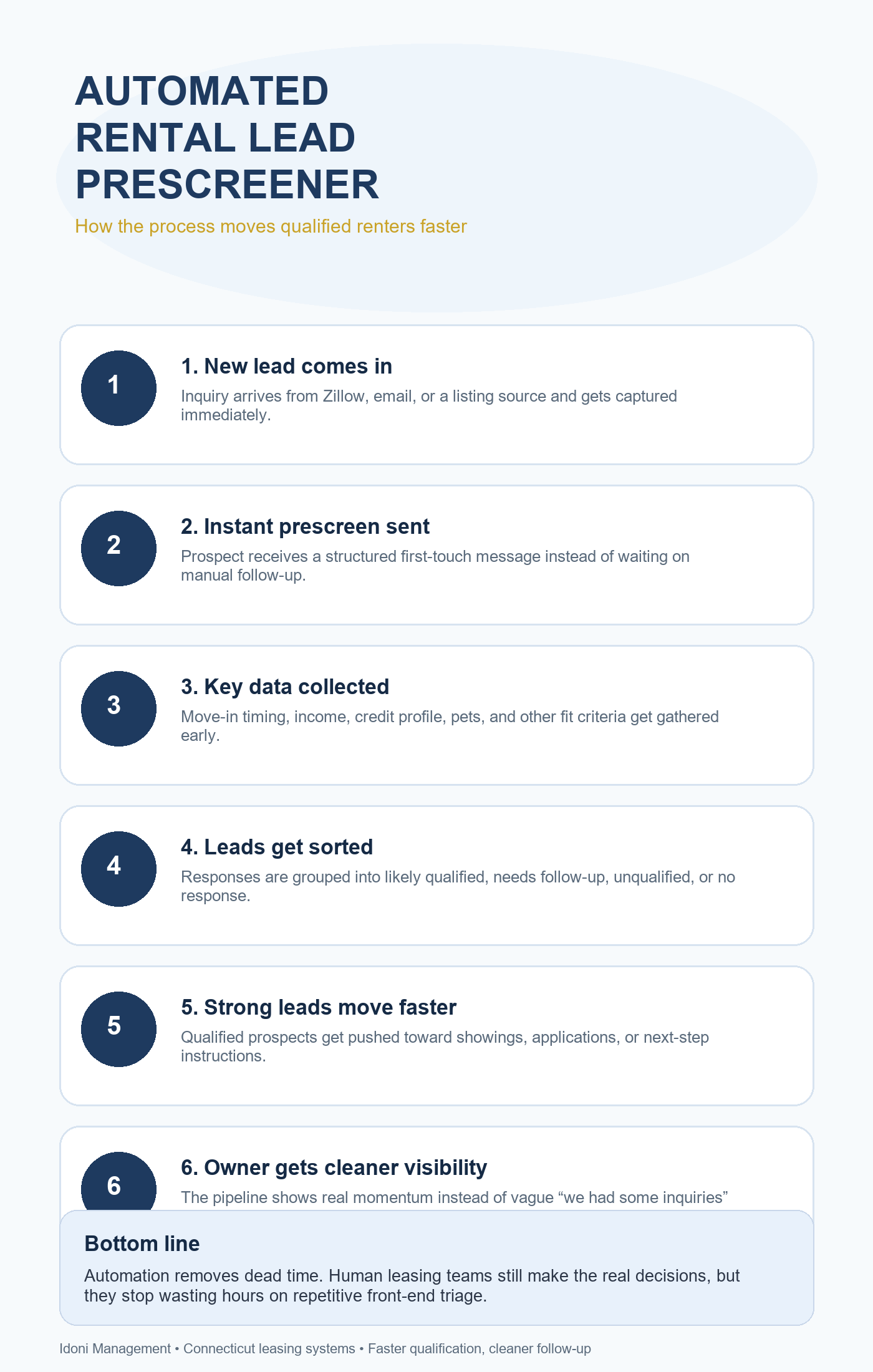
A solid prescreener typically handles the front end of the process like this:
1. The lead comes in
A prospect inquires through Zillow, email, or another listing source.
Instead of waiting for someone on the team to notice the inquiry, the system captures the lead immediately and ties it to the right property.
2. The prospect receives a structured prescreen prompt
The lead gets a fast first-touch response designed to collect the information that actually matters.
That can include:
- desired move-in date
- household size
- income level
- estimated credit profile
- pet information
- voucher status, when relevant
- other basic qualification factors tied to the property
This does two important things right away:
- it creates a faster experience for serious prospects
- it filters out weak or vague inquiries before they consume staff time
3. Responses get organized into a cleaner leasing funnel
Once the prospect replies, the system helps sort the lead into a more useful pipeline.
Instead of a leasing team opening a giant pile of random messages, they get a better operating view:
- likely qualified
- needs clarification
- unqualified
- no response yet
That alone can save a surprising amount of time.
4. Qualified prospects move faster
When the lead appears to fit the property, the next step can happen much faster.
That might mean:
- moving the prospect toward a showing
- sending next-step instructions
- triggering application guidance
- alerting the team that a strong prospect is ready
That speed matters because the best renters do not wait around forever. They move toward the listing where the process feels responsive, organized, and professional.
Why This Matters for Connecticut Landlords
Connecticut owners deal with enough friction already.
Between vacancy costs, turnover work, local compliance headaches, and the normal unpredictability of tenant demand, there is no reason the front-end leasing process should also be sloppy.
A strong prescreener helps owners in Connecticut by reducing one of the most common and expensive forms of drag: time wasted on the wrong leads while the right ones cool off.
That matters whether you own a single rental in Bridgeport or a larger portfolio spread across multiple cities.
If your process is inconsistent, every open unit becomes more expensive than it needs to be.
The Real Benefit Is Not Just Speed. It Is Better Filtering.
A lot of owners hear “lease faster” and think the whole pitch is speed for speed’s sake.
It is not.
Leasing faster only matters if you are moving the right people forward.
A good automated prescreener helps create a cleaner funnel by screening for fit early. That means your team spends more time on renters who actually have a chance of converting, and less time on dead-end inquiries that were never going anywhere.
That translates into:
- fewer wasted showings
- less manual follow-up
- less inbox clutter
- faster identification of strong prospects
- better visibility into where the leasing process is breaking down
That last part is underrated.
When you structure intake properly, you can learn a lot from the pattern of responses.
For example:
- Are leads coming in, but not replying to the prescreen?
- Are lots of people replying, but failing the same qualification point?
- Is the listing attracting the wrong renter profile?
- Is pricing too aggressive for the type of applicant the market is sending?
That is useful operating intelligence. Without a system, you do not really get that. You just get noise.
What Most Manual Leasing Pipelines Get Wrong
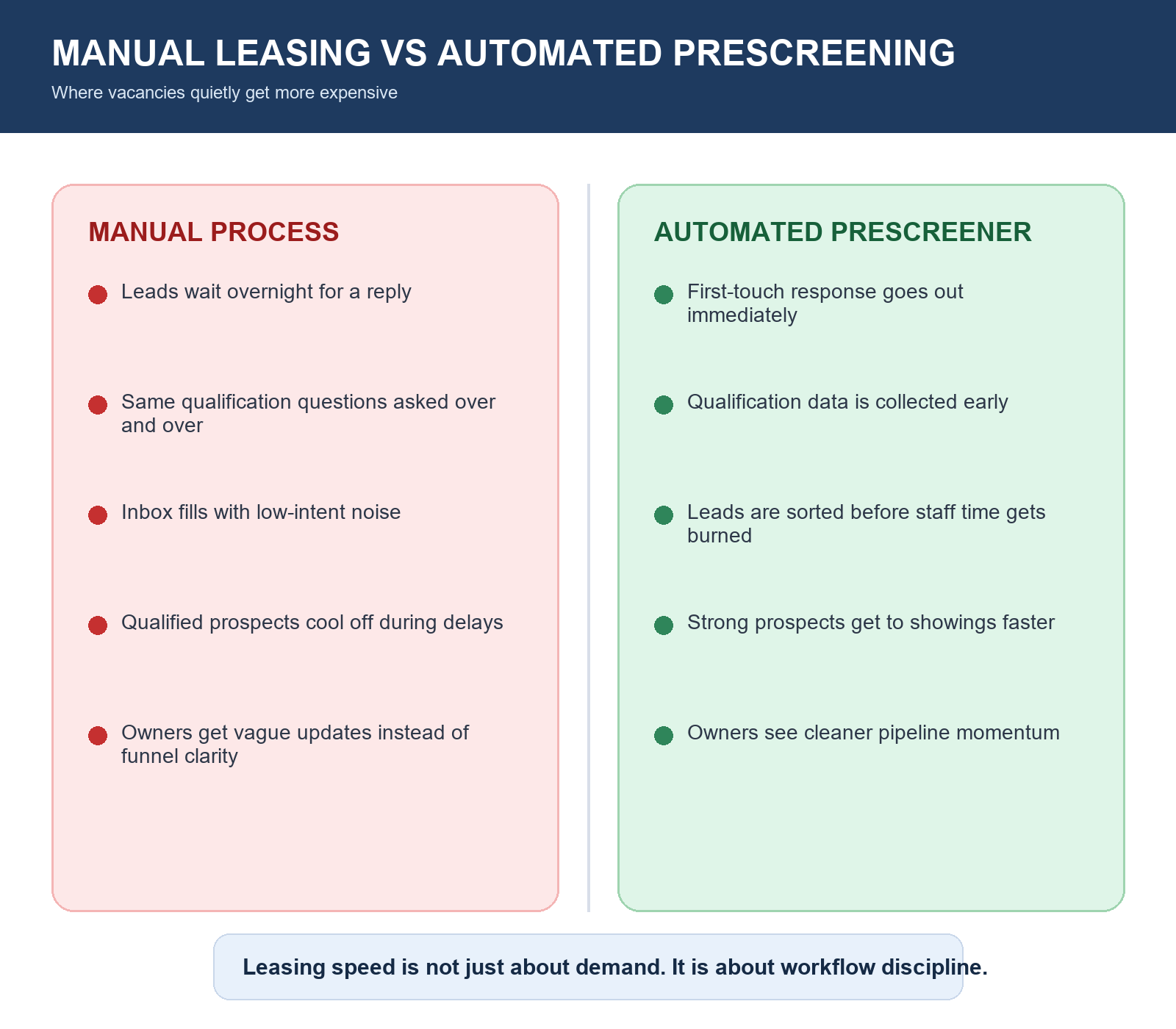
In a manual setup, the leasing team usually repeats the same cycle over and over:
- open inquiry
- respond manually
- ask the same qualification questions again
- wait for reply
- follow up again
- finally determine whether the prospect is viable
That is fine when lead volume is tiny.
It falls apart when you actually need consistency.
And the worst part is that manual pipelines tend to feel busy while still underperforming. Everyone looks occupied, but the system keeps bleeding time.
That is why some units sit longer than they should even when there is demand in the market.
Automation Should Remove Friction, Not Replace Judgment
This is the line that matters.
Automation should handle the repetitive front-end work. Humans should still handle the real judgment.
That means a good leasing system still leaves room for people to manage:
- exceptions
- nuanced prospect conversations
- final screening decisions
- owner communication
- strategy changes when the market shifts
The automation is there to eliminate wasted motion, not eliminate professional oversight.
In fact, when done correctly, it makes human judgment more valuable because your team is no longer buried in repetitive admin work.
Video: How Professional Screening Improves Tenant Quality
This short video is a good companion to the article because it shows how professional property managers think about screening applicants before moving them forward.
What Landlords Should Ask a Property Manager About Leasing Intake
If you are evaluating a property manager, do not just ask how they market a vacancy. Ask how they process demand once it arrives.
Here are better questions:
- How fast does a new rental lead get a first response?
- Do you prescreen before scheduling showings?
- How do you separate qualified and unqualified leads early?
- What parts of the leasing workflow are automated?
- What parts still require human review?
- How do you report leasing progress back to owners?
- How do you stop the team from wasting time on low-probability inquiries?
If the answer is basically, “our leasing agent handles it,” that is not really a process. That is a dependency.
Dependencies are fragile. Systems are durable.
The Idoni Approach
At Idoni Management, we believe property management should feel less reactive and more engineered.
That means building systems that:
- respond quickly
- qualify consistently
- reduce dead time
- create visibility for owners
- help the team focus where human judgment actually matters
Automated rental lead prescreening is one piece of that broader operating model.
It is not the entire leasing strategy, but it is a meaningful one because it protects the front of the funnel. And if the front of the funnel is sloppy, the rest of the process never gets a fair shot.
Bottom Line
If your rental is getting inquiries but still not leasing fast enough, the problem may not be lead volume. It may be the gap between inquiry and qualification.
That gap is where time gets lost. That gap is where good prospects disappear. That gap is where vacancy quietly gets more expensive.
An automated rental lead prescreener helps close that gap by:
- responding quickly
- collecting the right information early
- reducing manual back-and-forth
- filtering better before staff time gets wasted
- moving qualified prospects forward faster
That is how you build a leasing process that is not just active, but effective.
Want a Faster, Cleaner Leasing Process?
If you own rental property in Connecticut and want a more systematic way to handle leasing, Idoni Management can help.
We do not just list units and hope for the best. We build processes that reduce friction, improve visibility, and help qualified renters move through the funnel faster.
Want us to look at where your current leasing process is leaking time? Reach out to Idoni Management for a rental process review.